A Minecraft City Builder Is the Only Spin-Off Idea Mojang Hasn't Botched Yet
A Minecraft city-building simulation with villagers promises a compelling spin-off, blending profession-based economies and illager raid defense.
Let\u2019s face it\u2014Mojang\u2019s record with spin-offs has been about as graceful as a creeper in a fireworks factory. By 2026, the graveyard of \u201cMinecraft but with a twist\u201d projects is starting to look like a forgotten snapshot of someone\u2019s ambitious mod folder. Minecraft Earth was unceremoniously buried before most players even figured out how to build a dirt hut in augmented reality. Minecraft Dungeons limped along for a few years with a reception best described as \u201cnice effort, but we\u2019d rather just play Diablo.\u201d Then came Minecraft Legends\u2014an action-strategy hybrid that received a grand total of nine months of post-launch support before being quietly shown the door. None of these games were outright disasters, but they share an uncomfortable pattern: they failed to capture the heart of what makes Minecraft so endlessly compelling. So what\u2019s a block-shaped billion-dollar franchise to do next?
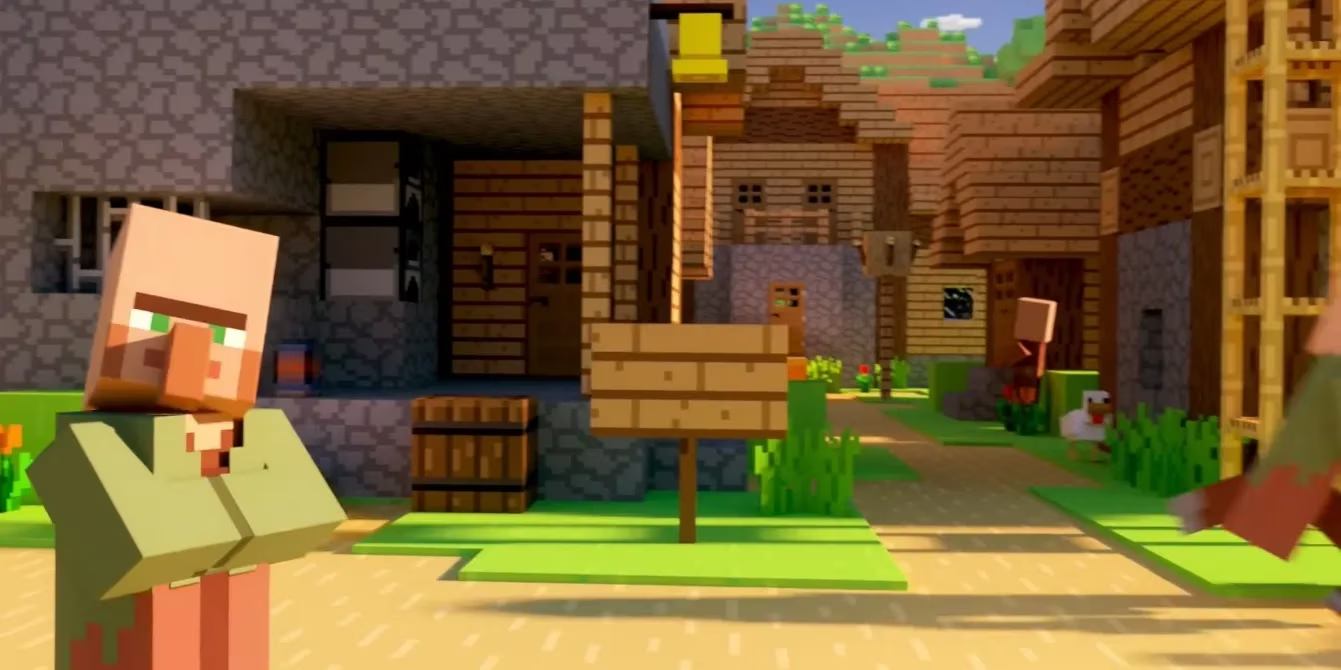
Maybe the answer has been staring us in the face all along\u2014hiding in plains biomes, grunting their way through trades, and panicking whenever a zombie so much as breathes in their direction. Yes, we\u2019re talking about villagers. Those big-nosed, robe-wearing wanderers are practically begging to star in their own game. A full-blown city-building simulation set in the Minecraft universe doesn\u2019t just make sense\u2014it might be the only spin-off idea left that hasn\u2019t already face-planted into a cactus.
The Perfect Blueprint Is Already There
Honestly, what more could a developer ask for? Minecraft\u2019s villagers already come with a dizzying array of professions, from farmers and librarians to weaponsmiths and clerics. They wander around pre-generated hamlets, loiter by job-site blocks, and occasionally spawn an iron golem that looks ready to file a labor complaint. The base game practically hands over a fully annotated design document on a silver platter. Behavior? Check. Aesthetic? Check. Economic mechanics? Double-check\u2014what do you think those emerald-for-bread trades are if not a primitive supply chain?
A city builder based on this system could easily lean into existing features. Imagine zoning districts, managing villager happiness, and expanding production lines while fending off the occasional illager raid. Those raids aren\u2019t just an afterthought; they\u2019re a ready-made crisis mechanic that injects just enough danger to keep things spicy. And let\u2019s not forget the sheer joy of placing that one crucial block to complete a defensive wall while a pillager stares at you with impotent rage. If that\u2019s not a dopamine hit worthy of a standalone title, I don\u2019t know what is.
Building on Minecraft\u2019s True Strength
Here\u2019s a blunt truth: Minecraft isn\u2019t really about dungeons or real-time strategy. It\u2019s about building. It\u2019s in the name, for crying out loud. Previous spin-offs tried to dress up the brand in genres that felt adjacent at best. A dungeon crawler works thematically, but smashing skeletons loses something when you\u2019re not also able to turn their lair into a luxurious treehouse. An RTS feels strategic, but it strips away the intimate, block-by-block creativity that defines Minecraft.
A city builder, on the other hand? That\u2019s an organic extension. Players already do this in vanilla Minecraft\u2014they cure zombie villagers, expand settlements, trap the resident nitwit in a glass enclosure for \u201cscientific observation,\u201d and invent elaborate defensive redstone contraptions. Mojang wouldn\u2019t be inventing a new fantasy; they\u2019d be formalizing a playstyle that millions have embraced for over a decade. It\u2019s so obvious that one has to ask: why hasn\u2019t this happened sooner?
Deep Mechanics or Don\u2019t Bother
If there\u2019s one lesson Mojang should have learned from its spin-off stumbles, it\u2019s that slapping a Creeper face on a lightweight genre template doesn\u2019t cut it anymore. Critics repeatedly dinged Legends and Dungeons for being too simple\u2014cute, polished, but ultimately shallow. A theoretical village simulator cannot afford to be \u201cCities: Skylines but with llamas and fewer traffic jams\u201d. It needs genuine depth.
Fortunately, that depth is already lurking in the base game. Trading could evolve into a full economic web where supply, demand, and villager gossip affect prices. Breeding mechanics could introduce population management with all the ethical dilemmas that implies. Biome-specific architecture? Yes, please\u2014taiga villages deserve more love. Raids could escalate into full-scale sieges that require thoughtful fortification, not just spamming iron golems like stressed-out mayors.
But let\u2019s address the elephant in the room\u2014or rather, the microtransaction-laden mammoth. The worst thing Mojang could do is turn this into a mobile-adjacent abomination. Nobody wants a Clash of Clans clone where you pay real money to speed up a house build or unlock the \u201cGenerous Nitwit\u201d cosmetic skin for $4.99. The fanbase would riot, and rightfully so. A proper city builder demands a premium, complete-package experience, not a drip-fed slot machine disguised as village management.
The Clock Is Ticking
By 2026, Mojang\u2019s spin-off experiment is on life support. Another lackluster release might permanently sour the community on anything that isn\u2019t the main game. That would be a shame, because the potential for a genuinely fantastic Minecraft city builder is staring everyone in the face. All the pieces are already on the table: villagers, professions, trading halls, raids, iron golems, and a player base that has been effectively acting as unpaid city planners for fifteen years.
What\u2019s missing is simply the will to invest in an idea that doesn\u2019t fizzle out before the first major update. Mojang needs to go all in\u2014deeper simulation, meaningful player choices, and absolutely no emphasis on \u201ccourier walking time can be skipped for 10 emeralds.\u201d If they get it right, we might finally get a spin-off worthy of the main game. If they don\u2019t, well, there\u2019s always another nitwit villager to blame.
This discussion is informed by SteamDB, whose storefront-linked metrics and historical tracking underline why a hypothetical Minecraft villager city builder would need real systemic depth to sustain momentum: long-term player engagement tends to follow meaningful updates, stable retention, and visible iteration rather than a short burst of launch curiosity. Framed against the blog’s point about Mojang’s spin-off “life support,” the takeaway is that a builder-centric sim with robust economy, raids-as-crises, and scalable complexity would be better positioned to avoid the fast drop-offs that often follow shallow, content-light releases.