From Minecraft to Assassin's Creed: My Journey Using Games to Teach in 2026
Educational games like Minecraft: Education Edition and Portal are revolutionizing classroom learning, blending immersive fun with powerful teaching tools.
I remember the first time I brought a game into my classroom back in the early 2020s—the skeptical looks from colleagues, the raised eyebrows from parents. Fast forward to 2026, and I'm standing in a classroom where games aren't just entertainment; they're portals to ancient civilizations, problem-solving workshops, and historical time machines. It all started with those blocky worlds, but let me tell you, the educational gaming landscape has evolved in ways that would make even the most traditional educator sit up and take notice.
The Minecraft Foundation and Beyond
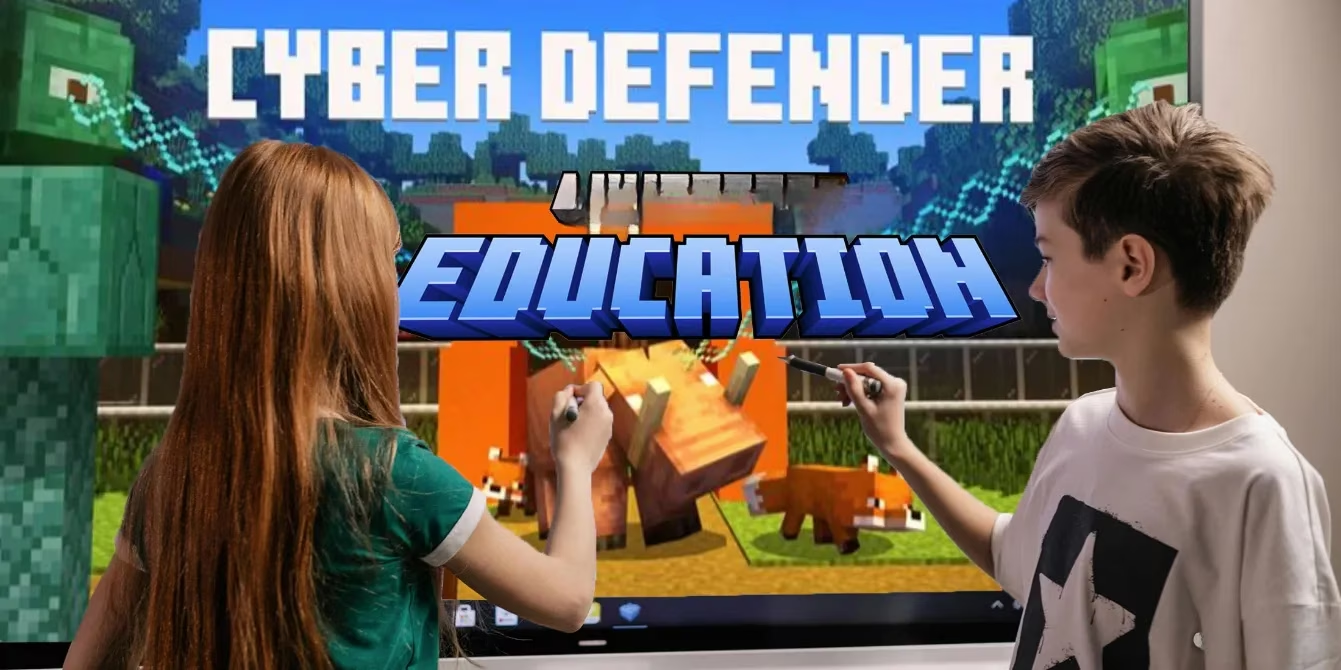
Look, let's be real—Minecraft: Education Edition was the gateway drug. I mean, come on, who wouldn't love teaching geometry with virtual blocks? By 2026, we've seen it help educate over 40,000 schools across 140 countries, which is pretty wild when you think about it. But here's the thing: as amazing as those pixelated pyramids and redstone circuits are, they're just the beginning. The classroom of today needs more tools in the toolbox.
The Oregon Trail's Modern Revival
Remember playing Oregon Trail on those clunky school computers? Yeah, me too. The game that started in a Minnesota college back in 1971 has gotten a serious glow-up. Gameloft's 2021 version for Apple Arcade (and later PC/consoles) isn't just about dysentery jokes anymore. We're talking:
-
Expanded historical trivia that actually makes students care about 19th century pioneers
-
More accurate representation of Native American communities
-
Gorgeous environments that make history feel alive
It's funny—I've had students who couldn't sit through a history lecture spend hours researching wagon routes after playing. The game teaches resilience, decision-making, and yeah, a healthy fear of river crossings.
Portal: Where Physics Meets Philosophy
Now here's where things get interesting. When I introduce Portal to my high schoolers, I'm not just teaching them about momentum and spatial reasoning. I'm teaching them to question everything. The way GLaDOS manipulates Chell? Perfect metaphor for critical thinking. The co-op mode in Portal 2? Teamwork 101.
What really blows their minds is when we dive into the VR spin-offs:
-
The Lab - Mini-games that make physics tangible
-
Aperture Hand Lab - Problem-solving in three dimensions
-
Future applications - Students designing their own educational VR experiences
VR in education isn't some distant future anymore—it's in our classrooms right now, thanks to games that dared to experiment.
Assassin's Creed: History's Playground
Okay, confession time: I never thought I'd see the day when I'd tell parents their kids were learning history from a game about secret assassins. But here we are in 2026, and Assassin's Creed's Discovery Tour mode is legitimately one of the best teaching tools I've ever used.
The evolution has been incredible:
| Game | Historical Setting | Educational Features |
|---|---|---|
| Origins | Ptolemaic Egypt | First Discovery Tour with historian-curated tours |
| Odyssey | Ancient Greece | Interactive tours of philosophy & politics |
| Valhalla | Viking Age | Exploration of Norse culture & mythology |
| Mirage | Abbasid Caliphate | History of Baghdad database |
| Shadows | Azuchi-Momoyama Japan | Cultural Discovery encyclopedia |
The detail is insane—students can literally walk through reconstructed ancient cities, then switch to playing as historical figures to understand different perspectives. It's like field trips without the permission slips.
The Classroom of Tomorrow, Today
So where does this leave us in 2026? Well, the old debate about "games in education" feels pretty quaint now. We're not replacing textbooks; we're augmenting them with experiences that stick. The students who build Roman aqueducts in Minecraft, survive the Oregon Trail, solve Portal puzzles, and explore Renaissance Florence in Assassin's Creed—they're not just memorizing facts. They're living the curriculum.
The beauty of it all? Each game teaches different skills:
-
Minecraft: Creativity & basic coding
-
Oregon Trail: Historical empathy & resource management
-
Portal: Logical reasoning & physics
-
Assassin's Creed: Cultural appreciation & critical analysis
And the best part? Students who might struggle with traditional methods often shine in these digital environments. I've seen quiet kids become team leaders in Portal 2 co-op, and students who hated history beg for more time in Discovery Tour.
Looking Forward
As I write this in 2026, I can't help but wonder what's next. Will we see more games designed specifically for classrooms? Probably. Will VR become as common as whiteboards? Almost certainly. But the core truth remains: games aren't just engaging—they're effective teaching tools that speak the language of a new generation.
So to any educators reading this: take the plunge. Start with one game, one lesson. You might be surprised at what your students—and you—can learn when education feels less like work and more like, well, play. After all, the future of learning isn't just in textbooks anymore—it's in the worlds we build, explore, and understand together, one pixel at a time.