How Mods Transform Our Favorite Games in 2026
Minecraft modding and Stardew Valley mods revolutionize gaming, offering endless creativity, deep customization, and immersive new worlds.
Ah, 2026. Here I am, still playing games that came out over a decade ago. Am I stuck in the past? Absolutely not! I'm living in a glorious, player-driven future where the original game is just a canvas, and the modding community holds all the paints. It's a beautiful thing, really. A game can launch to thunderous applause or a chorus of confused crickets, but its true legacy is often written years later by fans armed with code, creativity, and a burning desire to add just one more chair. Seriously, why can't we ever have chairs in the base game? The modding scene has completely reshaped what we expect from our digital playgrounds, turning finite experiences into near-infinite sandboxes.
Let's start with the pixelated elephant in the room: Minecraft. The official updates are great, don't get me wrong. But let's be honest, the time between them feels longer than a mining trip to bedrock with a wooden pickaxe. Enter the modders! These wizards have done the unthinkable. They haven't just added a new block or mob; they've built entire new worlds within the world.
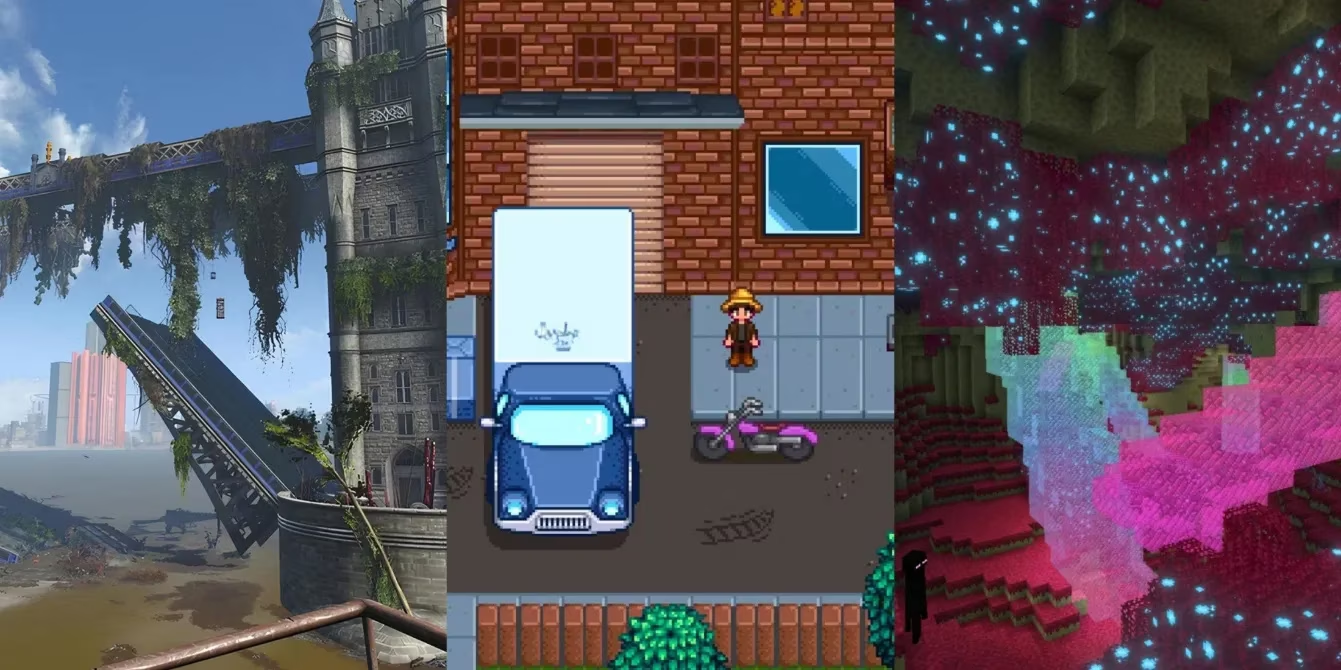
I mean, one day you're farming potatoes, the next you're stepping through a portal into the Twilight Forest, a sprawling dimension packed with unique bosses, dungeons, and atmosphere so thick you could build a house with it. It's not just dimensions, though. The base game's farming? Functional, but basic. Mods turn it into Stardew Valley's ambitious cousin, with dozens of new crops, complex cooking pots, and recipes that make your virtual chef's heart sing. And furniture! Oh, the furniture mods. Finally, I can make my dirt hovel feel like a home with a proper table, some chairs (see?), and a teddy bear for company. The list is endless:
-
Massive new dimensions to explore
-
Complete gameplay overhauls (magic, tech, you name it)
-
Deep farming and cooking systems
-
Aesthetic and building transformations
It's the ultimate "yes, and..." to Mojang's brilliant foundation.
Speaking of Stardew Valley, ConcernedApe is a legend for constantly updating his masterpiece. But even his generous spirit has limits. The modding community said, "Hold my Joja Cola." What started as quality-of-life tweaks has blossomed into what feels like official expansion packs. Want to move to a whole new town? Pack your bags for Ridgeside Village, a fully realized community with new characters, stories, and locations seamlessly stitched into the valley. It's mind-blowing.
The customization doesn't stop there. You can recolor the entire game to suit your vibe, swap out buildings for a cozy "Cottagecore" theme, or add entirely new romanceable characters with their own heart events. And for those of us who just want to chill? There are mods that automate watering, pet feeding, and chest organization. It’s the perfect balance between expansive new content and gentle quality-of-life improvements that make the pastoral life even more idyllic.
Now, let's talk about wastelands and wandering. Fallout 4 had a... let's say spirited reception. Yet, here in 2026, its modded communities are thriving like Diamond City after a rainstorm. Modders have taken the skeletal narrative and fleshed it out in incredible ways. Want to change the story's core? Mods like Subversion let you rewrite the Institute's fate. Want your synth son to actually, you know, travel with you? Father Companion makes it happen. It's narrative freedom the base game only hinted at.
And then there are the mods that are basically new games. Fallout London is the poster child—a total conversion that transplants you to a post-apocalyptic UK. But smaller-scale gems like Chaotic Sun create thrilling dungeon-crawling loops within the Commonwealth. The modding scene for Fallout 4 proves that a game's potential is only limited by its players' imagination, offering everything from new companions and quests to complete gameplay overhauls.
We cannot have this conversation without bowing to the old king: The Elder Scrolls V: Skyrim. Released in 2011, its bones are showing. The NPCs stare vacantly, the combat is clunky, and we've all memorized every line of dialogue from the town guards. But mods? Mods are the Fus Ro Dah that keeps this dragon flying. The scale is absurd. We're not talking about a new sword. We're talking about mods like Shumer and the Priest Kings, which adds:
-
Over 200 new locations
-
A staggering 180 new quests
-
More than 8,500 lines of professional voice acting
That's not DLC; that's a sequel made by fans! And it doesn't stop with content. Mods like Interesting NPCs populate the world with characters who actually have things to say, while Ordinator rebuilds the perk system from the ground up, making every playstyle feel fresh and powerful. From visual overhauls that make Skyrim look like a 2026 release to tiny tweaks that fix long-standing bugs, this game is the definitive modding success story.
Finally, let's get organized with Cities: Skylines. The base game is a fantastic city-builder, but any mayor will tell you that traffic management is a one-way road to madness. Cue the mods! Traffic Manager: President Edition is practically mandatory, giving you god-like control over lane logic, traffic lights, and public transport routes. It turns traffic from a frustrating puzzle into a satisfying system to optimize.
And the creativity extends far beyond infrastructure. Hate the ugly power lines? The Electric Roads mod hides them in your streets. Want to create a vast, realistic farmland? The Agricultural Field Collection has you covered. Feeling futuristic? The Quad mod injects a cyberpunk aesthetic with advanced, dense buildings. Whether you're recreating your hometown or building a metropolis of pure fantasy, the modding toolkit for Cities: Skylines is so robust it transforms the game from a simulation into an expression of pure artistic creativity.
So, what's the takeaway in 2026? The games we love are no longer static products shipped in a box (or a digital download). They are living platforms, sustained and reinvented by the passion of players. A mod isn't just a fix or a cheat; it's a love letter, a critique, and a wild "what if" experiment all rolled into one. It means that our favorite worlds never have to end. They just keep evolving, getting weirder, more beautiful, and more personal. And honestly? I wouldn't have it any other way. Now, if you'll excuse me, I need to get back to my modded Skyrim character—a chef who explores other dimensions to find rare ingredients. Don't judge.