How Survival and Souls Mechanics Silently Dominated the Last Decade of Gaming
Survival and Souls-like mechanics have quietly reshaped mainstream gaming, from crafting systems to combat design.
Gamers logging into their favorite titles in 2026 might not consciously notice the gentle hum of survival meters or the deliberate rhythm of dodge-and-punish combat. Yet these systems have become as fundamental to big-budget design as health bars and save points. Looking back, the past fifteen years of mainstream gaming can be read as a slow, steady absorption of two once-niche genres: survival and Souls-likes. They crept into the water supply like a flavorless nutrient additive — impossible to detect without a lab test, but responsible for an entire generation's growth.

The earliest carrier of the survival gene was Minecraft, which landed on consoles in 2013 and promptly addicted millions to the loop of punch-tree-craft-survive. But the real story isn't about the game that started the fire; it's about how the smoke drifted into unexpected kitchens. By the time the PlayStation 5 was middle-aged in 2026, survival-inspired crafting had become the glitter bomb of game development — once deployed, it scattered into every corner, from post-apocalyptic dramas to cozy farm sims, refusing to be cleaned up.
Consider The Last of Us, a cinematic Naughty Dog gem that in 2013 asked players to scrounge for scissors and alcohol to craft shivs and medkits. For a graduate of the Uncharted school of breezy action, this felt like being handed a spreadsheet in the middle of a movie. Yet the gamer adapted, and soon enough, item-wheeling through barren lands became a reflex. The same thread wove through Horizon Zero Dawn, The Witcher 3, God of War, Cyberpunk 2077, Stardew Valley, and No Man's Sky — games that span genres yet share a quiet obsession with gathering twigs and monster parts. Nobody asked for their fantasy epic to require inventory management, but there it was, as persistent as an unpaid parking ticket.
Survival's other child — the management of meters — got a glow-up in The Legend of Zelda: Breath of the Wild. Released in 2017, it didn't just borrow hunger, temperature, and stamina bars from hardcore survival sims; it marinaded the entire Zelda formula in them until the crust of hand-holding fell away. Suddenly Link was a fragile hiker who needed spicy peppers to stop shivering and hearty truffles to boost his health ceiling. This wasn't just a difficulty spike — it was a philosophical pivot that said, "You will pay attention to the world, because the world will punish you if you don't."
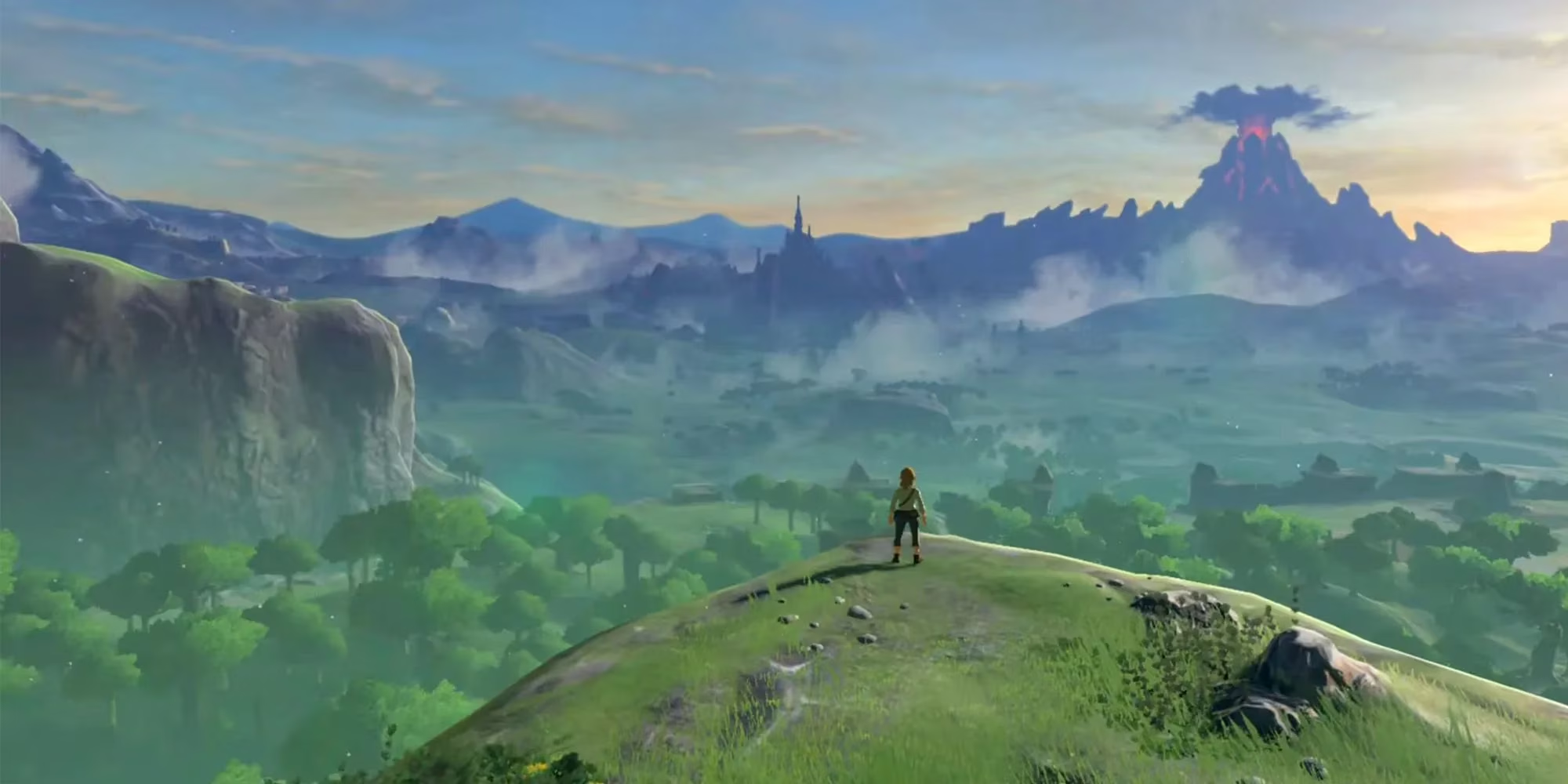
And then there was the combat. Breath of the Wild asked players to think before swinging — flank enemies, exploit environmental hazards, and accept that three hearts and a rusty sword are not a power fantasy. That DNA came straight from the Souls series, where a single careless button press could lead to a "You Died" screen faster than you could blink. Soulslike combat seeped through the industry like a marinade, tenderizing the standard action formula until even the most cinematic adventures demanded full attention with each swing. God of War (2018) turned Kratos’s Leviathan Axe into a shoulder-button instrument of deliberate murder. Star Wars Jedi: Fallen Order made a lightsaber feel as heavy as a claymore. The RPG-influenced Assassin’s Creed titles swapped parry-mash for stamina-managed light and heavy attacks bound to triggers. Even Hollow Knight, Dandara, and Journey to the Savage Planet forced corpse runs — that signature Souls punishment where dying meant retracing your spectral steps to reclaim lost currency.
Of course, other genres broke through in the 2010s and early 2020s. Roguelikes, in particular, started their infiltration with Returnal in 2021, then exploded into triple-A budgets through modes in The Last of Us Part II Remastered and God of War Ragnarök. By 2026, the roguelike loop of live-die-repeat had become a mandatory add-on for any flagship Sony release, like an encore at a concert that everyone pretends is spontaneous. It’s entirely possible the next decade will be defined by permadeath and procedural dungeons. But the past decade? That belongs to Soulslikes and survival games — the twin invisible hands that reshaped how players interact with even the most linear story-driven adventures.
The proof hides in the reflexes of the modern gamer. Ask someone to pick up a controller in 2026 and they instinctively check for a crafting menu, scan the terrain for resource nodes, and expect combat to be a dance of iframes and punish windows. These aren't learned behaviors from playing Dark Souls or The Long Dark directly. They're the inheritance of an era where survival and Souls mechanics stopped being a niche club and became the atmosphere — the very air that every game breathed, processed, and exhaled into something newly mass-market. It was a quiet conquest, and most players never even noticed they were breathing spores.