I Faithfully Recreated Rocket League's Arena in Minecraft and It's Pure Chaos
A meticulous Minecraft Rocket League arena crafted by MegaMinerDL replicates boost pads and sloped walls with blocky precision.
Stumbling through the endless blocky plains of my survival world last week, I did a double-take – there it was, a surreal monument rising from the ground like a pixelated fever dream. Someone had actually built a Rocket League arena in Minecraft, and it wasn't just a rough sketch; it was a love letter carved in blocks, every boost pad and angled wall a note in a song of vehicular soccer mayhem.
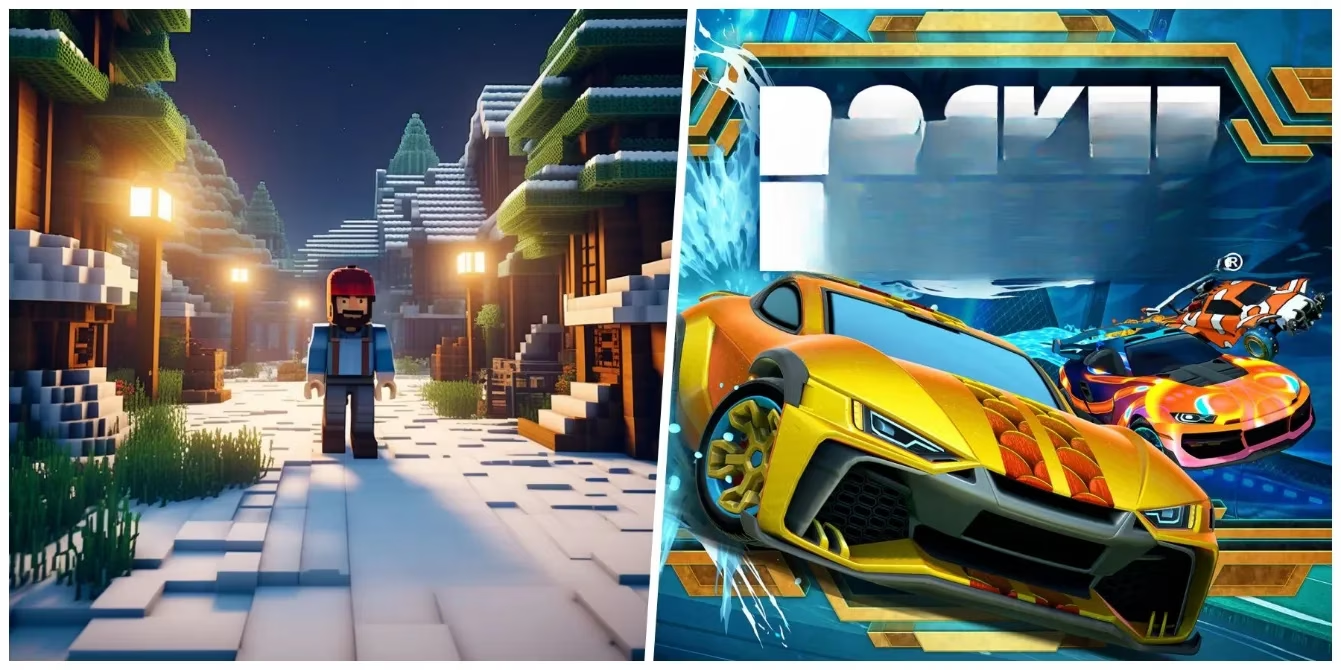
As a passionate player of both Minecraft and Rocket League since their early days, I've seen crossovers before, but this creation by MegaMinerDL felt like stitching two wildly different fabrics of my gaming soul together with a needle of pure creativity. The year is 2026, and both juggernauts are still evolving – Minecraft just dropped its Luminous Caves expansion, adding phosphorescent moss and underwater soundscapes, while Rocket League's Unreal Engine 5 overhaul brought ray-traced reflections to the ball itself. Yet here, in a world of cubes, was a snapshot of that glossy chaos, frozen and blocky, yet undeniably alive.
From Boost Pads to Goalposts: Dissecting the Blocky Madness
The first thing that hit me was the precision. The arena's proportions were a mirror image of Rocket League's DFH Stadium, but remixed with Minecraft's grammar. Tall, gently curving walls surrounded the pitch, their gradients achieved through layers of cyan terracotta and light blue concrete, mimicking the neon streaks that burn into your retinas during overtime. Boosting pads glowed with strategically placed sea lanterns behind glass, a subtle but genius substitute for the real game's energy rings. Even the center circle was etched in quartz, a compass rose of competitive promise. It felt like entering a cathedral where the gods were nitro-fueled battle-cars, and every block was a prayer to the beautifully absurd.
What truly elevated this build, however, were the micro-details. Redstone lamps flickered to simulate the countdown timer before kickoff. Item frames held golden nuggets as placeable ball tokens, and although they didn't roll, they evoked the same tense ballet of anticipation. I found myself weaving a metaphor: this arena was like a watchmaker's masterpiece, where every gear – or in this case, every slab and stair – had to align perfectly to create the illusion of fluid motion. One wrong block, and the whole dream of a drivable melee would shatter.
The builder, MegaMinerDL, shared their magnum opus on Reddit, and the thread quickly became a bonfire of admiration. I read every comment, grinning like a kid who'd just discovered a secret level. The top reply was pure gold: "Can you imagine combining Rocket League and Minecraft?" It's the question we've all whispered while air-rolling our Octane toward a do-or-die aerial. MegaMinerDL replied with a wish that I deeply echo: they'd love to see someone create actual code for Rocket League mechanics within the game – working cars, responsive physics, maybe even a real ball that can be booped by a piston-driven vehicle. That single comment became my own little muse. Because while this arena was already a playground of the imagination, the idea of playable car soccer in Minecraft sent my brain into creative overdrive.
The Ripple Effect: Community, Creativity, and Car Soccer Dreams
What struck me most wasn't just the build itself, but the conversation it ignited. In a world where gaming can sometimes feel fragmented, this structure acted like a lightning rod for shared joy. Players from both communities swapped ideas: could we build a rocket car out of honey blocks and observers that behaves like an Octane? Would datapacks let us assign boost meters with scoreboard values? This was more than a screenshot; it was a seed that sprouted a forest of possibilities. I've always believed that games like Minecraft and Rocket League aren't just about winning – they're about the clumsy, beautiful process of making something that shouldn't exist, exist.
In a way, this arena is a testament to how gaming in 2026 has matured. We're not just consumers of content; we're architects who carry our passions across title boundaries. It's like watching a virtuoso pianist sit down at a child's toy keyboard and somehow play Beethoven. MegaMinerDL took the limited palette of Minecraft blocks and rendered a high-octane speedway, proving that inspiration isn't constrained by technology – it's only constrained by how stubbornly willing you are to place block after block until the impossible suddenly blinks into reality.
I later attempted my own tiny tribute: a modest goalpost in my survival village, flanked by glowing coral fans as boost pads. It took me seven tries to get the symmetrical angles right, and I still accidentally set the roof on fire. That experience gave me a profound respect for the original creator. Building this arena was surely like trying to capture lightning in a bottle, but with wool and glass instead of glass bottles. Every successful slope must have felt like a tiny personal victory.
The Future is Blocky and Rocket-Powered
So where does this leave us? I've already seen whispers of a modding team inspired by MegaMinerDL's arena. They're prototyping a car entity using the new entity-model features from Minecraft's 2026 Tinkerer's Workshop update. I'm cautiously optimistic that within a few months, we might actually hear the familiar "Booom" of a goal explosion rendered in pixel art inside the game. Even if it never reaches full functionality, the arena itself stands as an icon of the cross-pollination that keeps both franchises vibrant. Whenever I load into a server and see that neon glow on the horizon, I'll remember that creativity isn't a resource to be farmed – it's a rocket league match that never ends, where the only limit is your redstone knowledge and your willingness to try the most ludicrous ideas.
So, grab your pickaxe and your boost canisters. The next time someone tells you that two games can't blend, point them to this glorious patch of blocks where cars might someday fly.