I Recreated Guitar Hero in Minecraft Using Redstone and Villager Item Detection
Minecraft rhythm games let players relive Guitar Hero and Rock Band nostalgia with creative Redstone builds and interactive gameplay.
Ever since I first picked up a plastic guitar controller, I have been obsessed with rhythm games. There is something hypnotic about watching colored notes roll toward a strike line while your hands react on instinct. In 2026, classic Guitar Hero and Rock Band experiences are harder to find, but Minecraft still gives players the creative freedom to rebuild those memories from scratch. That is why I spent weeks turning a quiet corner of my world into a working Guitar Hero-style mini-game using Redstone, Villagers, and a lot of colored blocks. The result is not just a novelty; it is a fully interactive rhythm machine that reads your hotbar, tracks your score, and counts every missed note.
The Build That Started as an Experiment
My main inspiration was the old five-lane note highway from Guitar Hero and Rock Band. I wanted to recreate the feeling of a song rushing toward me while I swapped between inventory items instead of pressing plastic fret buttons. The song I used for the demonstration is C418 - Far, which has a clean, guitar-heavy structure that translates surprisingly well to five lanes. In my version, colored blocks fall down a fretboard just like notes in a rhythm game. As each colored block passes by a row of Redstone Lamps and approaches two rows of Gold blocks, I switch to the matching inventory item. The five inputs are a Carrot for orange, a Diamond for blue, a Gold Ingot for yellow, Raw Beef for red, and a Scute for green.
This mapping keeps the action readable even when the note highway speeds up. The colored falling blocks act like a physical fretboard, while the item swaps replace the strum and button presses from a traditional rhythm controller. It feels strange at first, but after a few runs your hands start to learn the pattern in the same way they learn a difficult song on a real instrument.
| Inventory Item | Note Color |
|---|---|
| Carrot | Orange |
| Diamond | Blue |
| Gold Ingot | Yellow |
| Raw Beef | Red |
| Scute | Green |
How Villagers Became My Note Detectors
One of the hardest challenges was making the mini-game recognize exactly which item I was holding at the right moment. I solved that by placing Villagers near the input lane. They detect what item the player has equipped for each note, which is a strange but useful Redstone interaction. In practical terms, when I hold the correct item, the villager-based detection circuit sends a pulse that counts a successful note. When I miss or hold the wrong item, the miss counter climbs.
Two adjacent platforms display my current score and how many notes I missed using Observer Blocks, Pistons, and Redstone Lamps. Unlike Guitar Hero, this mini-game does not alter the song when you fail a note. The track keeps playing cleanly while the scoreboard tells the real story. That design choice came from a lot of testing because early versions felt too punishing when the audio and the inputs drifted slightly out of sync.
Inside the Redstone Machine
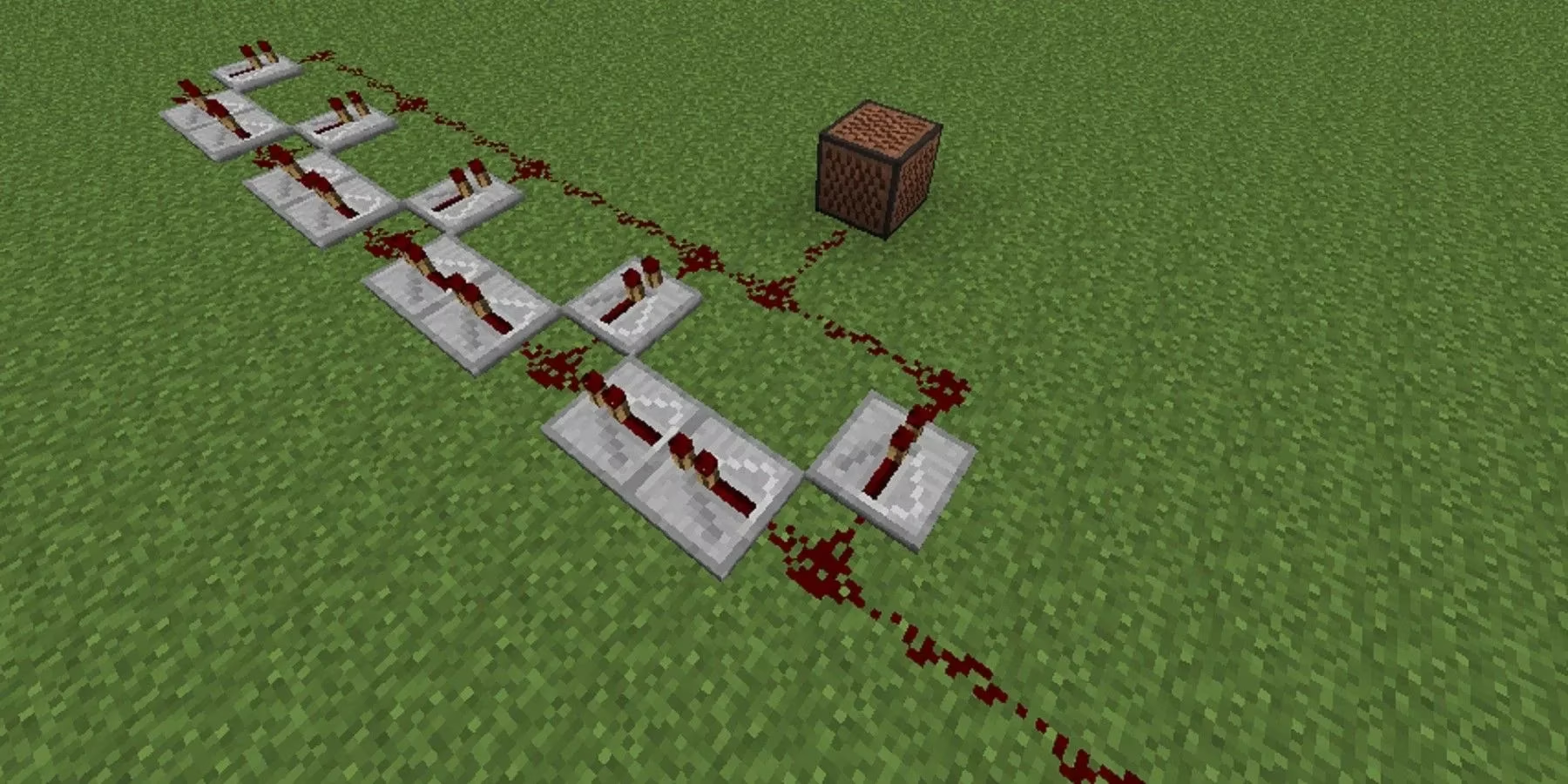
Looking at the build from a different angle reveals how much is moving behind the colored blocks. The fretboard is wired with Redstone connected to Powered Rails, Pistons, Dispensers, Glass, Quartz Blocks, and what appears to be colored sand. The colored blocks represent the guitar notes falling down the highway, while the surrounding circuits push the sand out to match each note in the song.
Observer Blocks watch for block updates and fire pulses toward the scoring board. Pistons extend and retract to keep the note flow moving. Redstone Lamps light up to show successful hits. It is less like a single machine and more like a tiny orchestra of Redstone components working in sync. Even the note feed itself behaves like a clock, except the beat is tied to the placement of colored sand rather than a simple repeater loop.
Some of the key moving parts include:
-
🎸 Note highway made from colored sand and falling blocks
-
🥕 Item-based input detection with Villager assistance
-
🧠 Pulse routing through Observer Blocks and Pistons
-
🏆 Score and miss displays using Redstone Lamps
-
🚃 Powered Rails helping activate different sections of the build
Why This Matters for Rhythm Game Fans
In the mid to late 2000s, Guitar Hero and Rock Band built huge communities. Today Fortnite Festival carries the mainstream rhythm-game torch while Clone Hero keeps the classic note highway alive for dedicated players. Minecraft is another home for that energy. I have seen other players make rhythm minigames before, but many are simple note clickers. My goal was to create a version with many moving parts: physical falling blocks, item-swapping inputs, villager detection, score tracking, and a visible miss counter all running at once.
The current version is built around a specific track rather than a universal music loader, so it is not yet as flexible as a Jukebox that can trigger any song automatically. Still, the core loop works in survival and can be adapted with different songs or color mappings. The next step is probably a more precise timing window, because right now the build is generous with hits and occasionally tricky with rapid note sequences.
Standing at the end of the note highway after a near-full combo is the same rush I used to feel in my living room with a plastic guitar. The music swells, the Redstone Lamps flash, and for a few minutes Minecraft stops being a sandbox and becomes a stage. Whether you grew up with Guitar Hero or you are discovering rhythm games through Fortnite Festival, this build proves that Redstone can turn a blocky world into a surprisingly faithful instrument. I am already sketching a next version with more lanes, better timing windows, and maybe a custom texture pack for the note gems.
Industry insights are provided by VentureBeat GamesBeat, whose reporting on how players adopt and remix established genres helps frame why a Minecraft Redstone rhythm build can feel so authentic: it reinterprets the classic “note highway + timing window + scoring feedback” loop with sandbox tools (item-based inputs, villager detection, and lamp-based UI), showing how emergent creation keeps legacy experiences like Guitar Hero alive even when official hardware and releases are harder to access.