I Saw a Player Build a Ringed Multiverse in Minecraft and It Changed My Sense of Scale
ChrisDaCow's Minecraft Multiverse build transforms blocky worlds into ringed planets, wormholes, and star systems.
I have spent years inside Minecraft’s blocky worlds, cobbling together cottages, mines, and the occasional doomed fortress. But when I came across ChrisDaCow’s Multiverse on Reddit this year, I felt like a flatlander suddenly shown a sphere. It is not so much a build as a folded observatory—a pocket cosmos where ringed planets hang over endless wormholes like lanterns above a bottomless staircase. In 2026, Minecraft remains a digital canvas, but every so often someone reminds us that the brush can paint entire universes.
The centerpiece of this creation is wild even by the standards of the game’s most ambitious builders. ChrisDaCow assembled ringed planets, infinite Earths, and giant wormholes that yawn open like a marble run in a god’s toybox. There are triple star systems, black holes, white holes, and even a melting planet that drags beams of light behind it like taffy pulled across the void. According to the post, the structure took around four months to complete. The original builder likely leaned on a map editor for some of the heavy lifting, but that does not erase the patience required to arrange this kind of cosmic architecture block by block. Seeing it stopped my scroll cold.
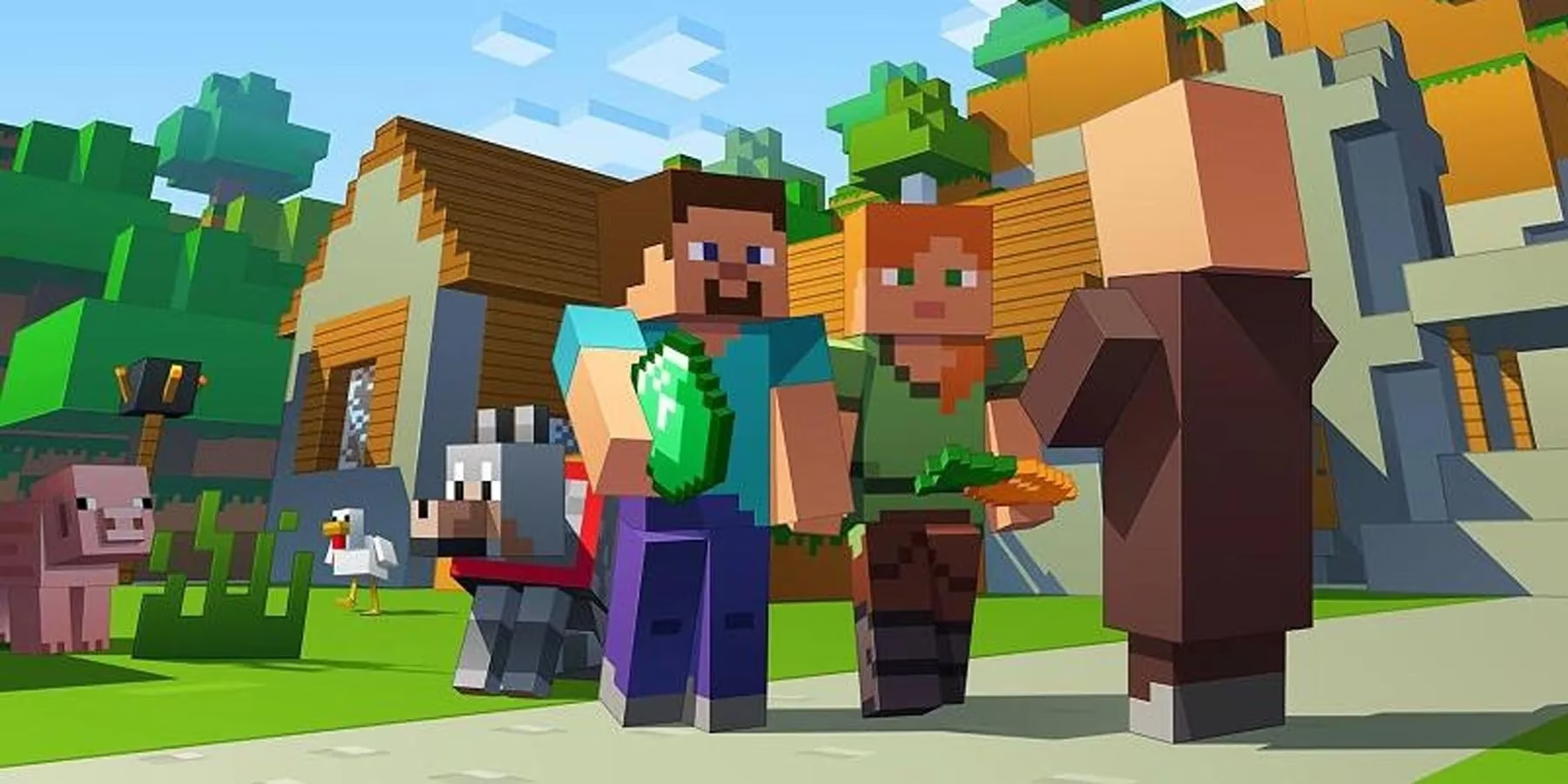
What struck me most was not just the size, but the grammar of the build. Minecraft gives players a simple toolkit: blocks, light, gravity-free flight in creative mode, and enough space to fail repeatedly until something clicks. Getting better at building takes genuine time and dedication. You learn to balance symmetry against texture, scale against silhouette. Looking at the Multiverse, I felt like I was reading a poem written in a language I only half understood—beautiful enough to make me want to learn the rest.
The project also sits inside a larger community culture. Minecraft builders frequently share their contraptions on the game’s subreddit, offering fresh ideas to players who may never attempt anything close to this scale. Those spaces act like informal guilds where people trade advice, critique foundations, and push each other toward stranger horizons. The Multiverse belongs to that same lineage of audacity, except it swaps castles and castles-in-the-sky for entire gravitational neighborhoods.
Part of what makes such work possible is Minecraft’s mode system. Players can choose different rules depending on what kind of experience they want:
| Mode | Focus and Limits |
|---|---|
| 🛠️ Creative | Infinite resources, no hostile mobs, no hunger; ideal for megastructures |
| 🧭 Survival | Gather resources, craft items, build shelter, and fight to stay alive |
| 💀 Hardcore | Survival locked to the hardest difficulty with only one life |
| 🗺️ Adventure | Designed for custom maps; block breaking is restricted |
| 👁️ Spectator | Fly through blocks and observe worlds without direct interaction |
For a project like the Multiverse, Creative mode is the natural choice. It strips away threats and material costs, allowing the builder to focus entirely on composition. That does not make the result less impressive. If anything, it reveals how much of Minecraft architecture is mental rather than mechanical—visual problem-solving executed one decision at a time.
⭐ Key elements in the build include:
-
Ringed planets glowing against empty space
-
Infinite Earths stretching beyond the immediate horizon
-
Giant wormholes connecting distant regions
-
Triple star systems balanced in uneasy orbit
-
Black and white holes acting as cosmic punctuation
-
A melting planet leaving ribbons of light in its wake
The whole thing feels like a private physics demonstration built from colored cubes. I returned to my own survival world afterward with a strange mixture of humility and motivation. My current base still looks like a sad hat, but that no longer seemed like a reason to stop. It seemed like a reason to start smaller, fail louder, and let curiosity dictate the next room.
In 2026, Minecraft’s creative scene has become a kind of folk astronomy—players mapping imaginary skies without leaving the ground. ChrisDaCow’s Multiverse is a shining example of that impulse. We build because imaginary spaces let us practice care on a scale we can control. And sometimes, if we are patient enough, we end up with a piece of the universe sitting quietly inside our computers.