Minecraft's New Update Era: A Gradual Evolution of Combat
Minecraft's 2026 micro-update strategy, exemplified by the Pale Garden, revolutionizes combat evolution through incremental, precise refinements rather than a single, monolithic overhaul. This brilliant approach allows for the revival of lost features and fosters a dynamic, responsive dialogue with the community, ensuring each addition is masterfully polished.
The landscape of Minecraft development has shifted seismically in 2026. Mojang Studios' transition from monolithic annual updates to a steady stream of smaller, more focused content releases—exemplified by the recent Bundles of Bravery and the upcoming Pale Garden—has fundamentally altered the game's evolutionary rhythm. This new paradigm, while brimming with potential for refined iteration, casts a long shadow over one of the community's most fervent and long-standing desires: a comprehensive combat overhaul. For years, players have yearned for a single, transformative update to address the divisive legacy of the 1.9 combat changes, envisioning a revolution akin to the Nether Update's dimensional rebirth. Yet, the era of micro-updates suggests a different, more methodical future, where combat will evolve not in a single cataclysmic event, but through a series of deliberate, incremental refinements spread across the calendar.
The Micro-Update Philosophy: Precision Over Power
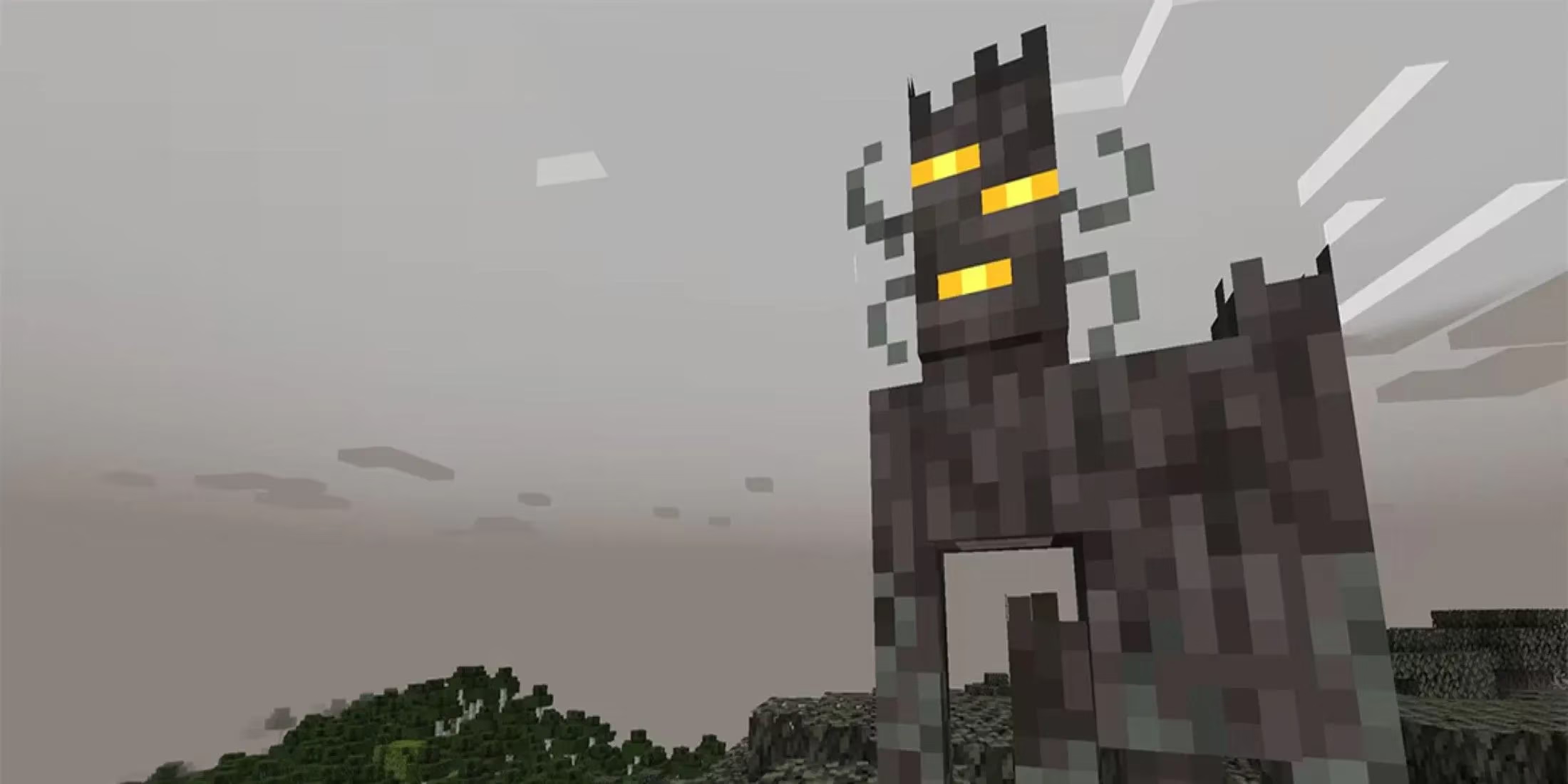
The new structure dismantles the old expectation of a grand "Combat Update." Instead of a sweeping revamp, Mojang is now positioned to surgically adjust individual facets of combat, one update at a time. This approach is less like forging a new sword in a single, fiery strike and more like the patient work of a master watchmaker, delicately tuning each tiny gear to improve the whole mechanism's function. The recently announced Pale Garden micro-update serves as a prime blueprint for this philosophy. It introduces a new biome centered entirely on a unique combat puzzle: the Creaking mob. This entity, a chilling homage to Weeping Angels, immobilizes when observed but can only be damaged by destroying a specific block hidden in the environment, forcing players into a tense dance of attention and vulnerability. This isn't about adjusting swing cooldowns or damage values; it's about introducing novel situational mechanics that revitalize engagement on an intellectual level.
Previous updates under this model have already laid groundwork. The Armored Paws update didn't just add wolf armor; it integrated a new tactical layer into exploration and combat, transforming wolves from charming companions into resilient allies. Fan feedback during this update's lifecycle was instrumental in shaping the armor's utility, demonstrating how the micro-update cycle fosters a responsive dialogue between developer and community. This iterative process allows features to be introduced, tested, and refined in the wild, much like a sculptor revealing a form from stone by carefully removing one chip at a time, guided by the material's response.
Revisiting the Archives: A Second Chance for Lost Experiments
This new, measured pace of development opens a fascinating door to Minecraft's past. It creates the perfect environment to revisit and reintegrate forgotten experiments that were once too radical for a major numbered update. The most notable of these are the 2019 Combat Snapshots spearheaded by lead developer Jens "Jeb" Bergensten. These experimental builds, shared via Reddit, proposed a suite of changes designed to diversify combat strategy:
| Proposed Change (2019 Snapshot) | Potential Impact in Micro-Update Era |
|---|---|
| Nerfed axe damage on Java Edition | Could be rebalanced in a "Tool Tuning" update. |
| Enhanced importance of potions & throwables | Could be the focus of an "Alchemist's Arsenal" update. |
| Adjusted weapon sweep attacks | Could be part of a broader "Crowd Control" mechanic tweak. |
These snapshots represented a different vision for combat—one that emphasized preparation, consumables, and tactical choice over sheer DPS (Damage Per Second). In the context of 2026's update structure, ideas like these could be polished and released as self-contained features. A small update could, for instance, finally make splash potions and lingering potions a cornerstone of player-versus-environment (PvE) and player-versus-player (PvP) strategies, fulfilling a long-held community wish without needing to rebuild the entire combat engine from scratch.
The Path Forward: Unification Through Evolution
The ultimate promise of this gradual evolution may lie in edition unification. The divide between Java and Bedrock Edition combat mechanics has been a persistent point of discussion. The micro-update model provides a stable platform to carefully align these systems. Instead of a risky, all-at-once synchronization that could disrupt both player bases, changes can be tested and implemented in parallel, one mechanic at a time. The process would be akin to weaving two distinct threads into a single, stronger cord, each small twist bringing the strands closer together without risking a sudden snap.
Looking ahead, the future of Minecraft combat under this new regime is one of curated enrichment. Players can anticipate updates that might introduce:
-
A single new weapon type with unique properties, released alongside a mini-biome where it shines.
-
A revision of dual-wielding mechanics, perhaps allowing for shield-and-torch or potion-and-sword combinations.
-
New armor upgrade paths that exist alongside, but distinct from, the traditional enchantment system.
-
Mob-specific interactions, expanding on the Creaking's concept to make fighting different creatures a unique puzzle.
This is not the explosive revolution some players dreamed of, but rather a quiet, persistent evolution. The combat system will change, but it will do so like a river carving a canyon—through consistent, focused effort over time. Each micro-update acts as another drop of water, gradually shaping the landscape of gameplay. For a game as enduring as Minecraft, this may be the most sustainable path forward, ensuring that its combat continues to grow and intrigue players for another decade to come. The era of the mega-update has passed; welcome to the age of meticulous, meaningful iteration.