Minecraft's Skyward Evolution: Why a Sky Island Biome is the Game's Next Logical Leap
Minecraft sky island biome and Elytra unlock thrilling new adventures, redefining vertical exploration and creative possibilities in the game.
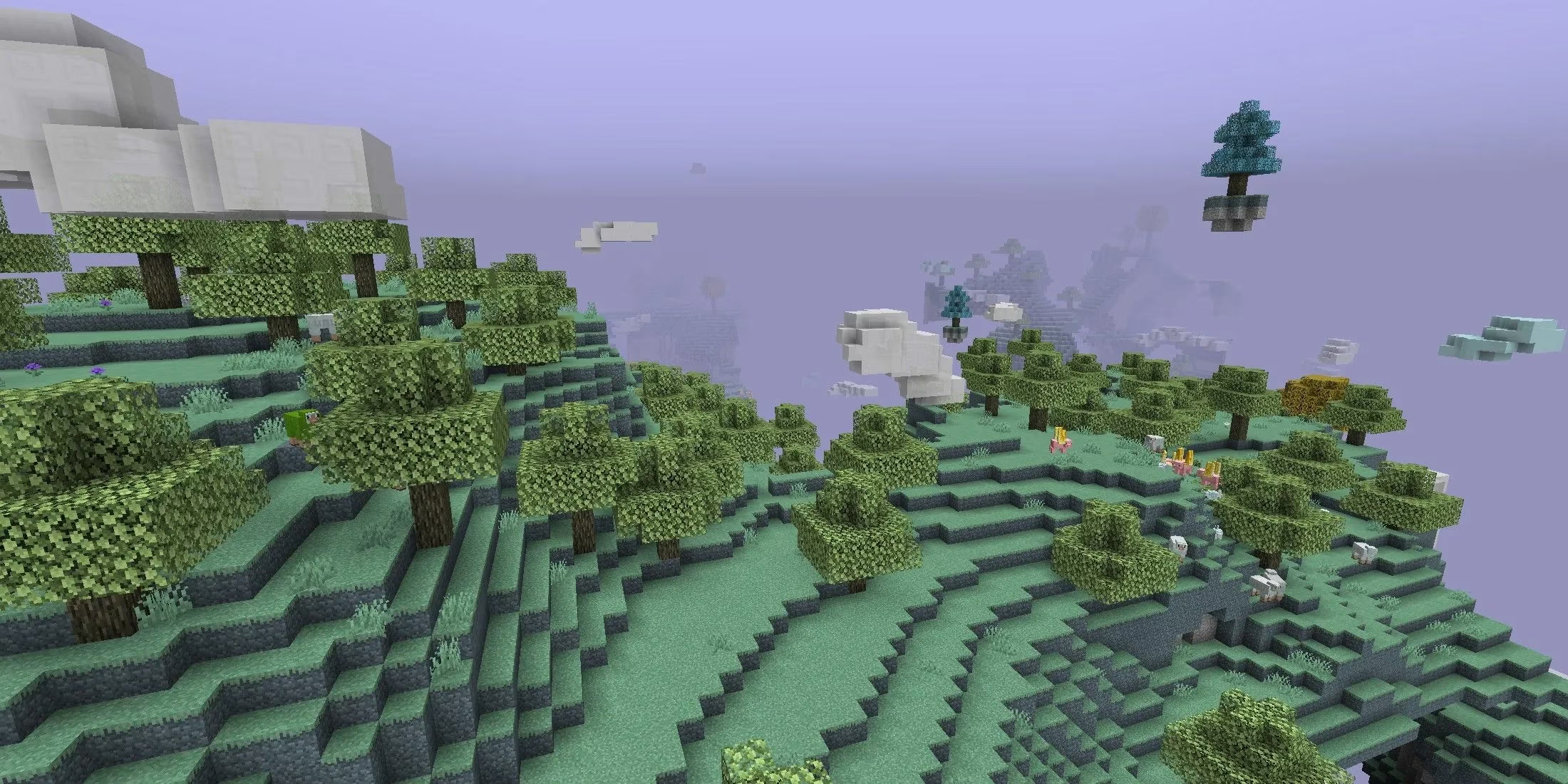
In the ever-expanding universe of Minecraft, one celestial dream has persistently captivated the collective imagination of its global legion of builders and adventurers: the concept of a true sky island biome. For years, this vision has shimmered on the horizon, tantalizingly out of reach in the vanilla game, yet living vibrantly through the sheer force of player creativity in mods, minigames, and wistful glances at floating mountain chunks. As Mojang charts a bold new course with its agile, multi-update development strategy pioneered in 2024, the stars have finally aligned. The studio's recent forays into niche, experimental content—like the hauntingly beautiful Pale Garden and the enigmatic Creaking mob—have proven that Minecraft's world is still ripe for profound, focused expansion. This innovative approach isn't just changing how updates are delivered; it's fundamentally reshaping what is possible, creating the perfect atmospheric conditions for a biome that exists not on the earth, but among the clouds.
The Unquenchable Thirst for the Heavens
Minecraft players possess an almost gravitational pull toward the sky. It's a phenomenon as reliable as the day/night cycle. Witness a mountain generated with a rebellious chunk suspended defiantly in the azure void, and watch as nearly every player becomes an instant geologist and architect, their minds racing with possibilities for a breathtaking aerial base. This isn't a casual interest; it's a deep-seated desire for vertical exploration and conquest. The monumental success of community creations like the Skyblock minigame and the legendary Aether mod aren't mere coincidences—they are undeniable proof of concept. They represent a massive, unmet demand within the core gameplay loop. Players are biologically—or perhaps, block-ologically—predisposed to seek secrets in high places. The tragicomic reality, however, is that after the 1.18 update dramatically increased the world height to a staggering 319 blocks, the upper atmosphere became a vast, empty canvas. It's a silent, yawning expanse that practically screams for content. When you compare this to the beloved, loot-filled floating islands of games like Terraria, the absence in Minecraft feels less like a design choice and more like a glaring omission waiting to be filled with clouds, adventure, and rare resources.
The Elytra's Destiny: From Tool to Key
At the heart of this skyward revolution lies an item already steeped in legend: the Elytra. Currently, it's the ultimate tool for efficient, if somewhat straightforward, traversal. But imagine, just for a moment, if its purpose was transformed. A fully-realized sky island biome wouldn't just be a place to use the Elytra; it would be the reason for its existence to evolve. The Elytra would cease to be a mere transport aid and ascend to become the literal key to a new dimension of gameplay.
-
Revitalizing Exploration: The initial, heart-stopping thrill of finding your first Elytra in an End Ship and gliding over the alien archipelago is a core memory for millions. A sky island biome offers a chance to relive and expand that magic, providing a perpetual, renewable source of that wonder right in the Overworld.
-
Introducing Aerial Challenge: Let's be honest—once mastered, Elytra flight with fireworks can make other transport methods seem quaint. While the debate about balance rages on, sky islands present an elegant solution: aerial obstacles. Navigating through narrow canyons of floating rock, dodging volatile cloud-based mobs, or landing precisely on small, drifting islets would inject much-needed skill and tension back into flight. It would no longer be a simple point-A-to-point-B teleport; it would be an adventure in itself.
-
Creating Skybound Detours: One limitation of high-altitude flight is losing touch with the rich, ground-level biomes. A sky island biome solves this by bringing the detour up to you. It creates a layered world where exploration isn't just horizontal, but profoundly vertical, giving the Elytra a complex, engaging role similar to a boat in an ocean or a horse on a plain.
A Blueprint for a Cloud Kingdom
So, what would this biome actually look and feel like? It must be more than a few dirt blocks hovering over a taiga. It needs its own identity, ecosystem, and reasons to risk the long fall.
| Feature | Concept & Purpose |
|---|---|
| Geography | Archipelagos of islands with varying themes: lush, vine-draped gardens; barren, wind-sculpted rock spires; crystalline shards humming with energy. |
| Resources | Exclusive, high-value materials found only in the clouds. Think of lightweight alloys for advanced redstone, rare gases for new potions, or seeds for unique, floating flora. |
| Mobs | Creatures adapted to the thin air. Perhaps graceful, neutral Gliders that ride thermals, or territorial Rocs that nest on the highest peaks and guard precious loot. |
| Structures | Derelict, ancient sky vessels; temples built on impossible physics; nomadic trading outposts accessible only by air. |
| Hazards | Turbulent wind currents that alter flight paths, localized lightning storms, and the ever-present, gut-wrenching risk of a missed landing. |
Implementing such a biome under Mojang's new, iterative update model is not only feasible but ideal. It could be introduced as an experimental feature in a snapshot, refined based on overwhelming player feedback—something the community would undoubtedly provide with passionate intensity—and then fully integrated. It aligns perfectly with the studio's demonstrated willingness to explore specific, atmospheric concepts like the Pale Garden. By 2026, the tools, the player desire, and the development philosophy have all converged. The foundation is built. The launch pad is clear. All that remains is for Mojang to give the signal, strap on its own Elytra, and lead the charge into Minecraft's final frontier: the boundless, beckoning sky. The clouds aren't the limit; they're just the beginning.