Starfield's Journey: How Post-Launch Updates Shape Its Legacy and Future
Starfield's controversial journey from divisive launch to redemption through transformative updates like REV-8, before facing the Shattered Space expansion's mismanaged expectations, highlights its rollercoaster life cycle.
Looking back from 2026, I can't help but reflect on the wild ride that has been Starfield's life cycle. It's been a game that has consistently lived in the extremes of public opinion, much like The Last of Us 2 did in its time. From the moment it launched, players seemed to either passionately defend its ambitious, sprawling vision or harshly criticize its perceived shortcomings, with very little middle ground. This intense debate wasn't just about the game itself; it felt like a referendum on Bethesda Game Studios' entire design philosophy and their place in the modern gaming landscape. The discourse was everywhere, and it forced everyone, including the developers, to confront some hard questions about what players truly want from a massive, open-world space epic.
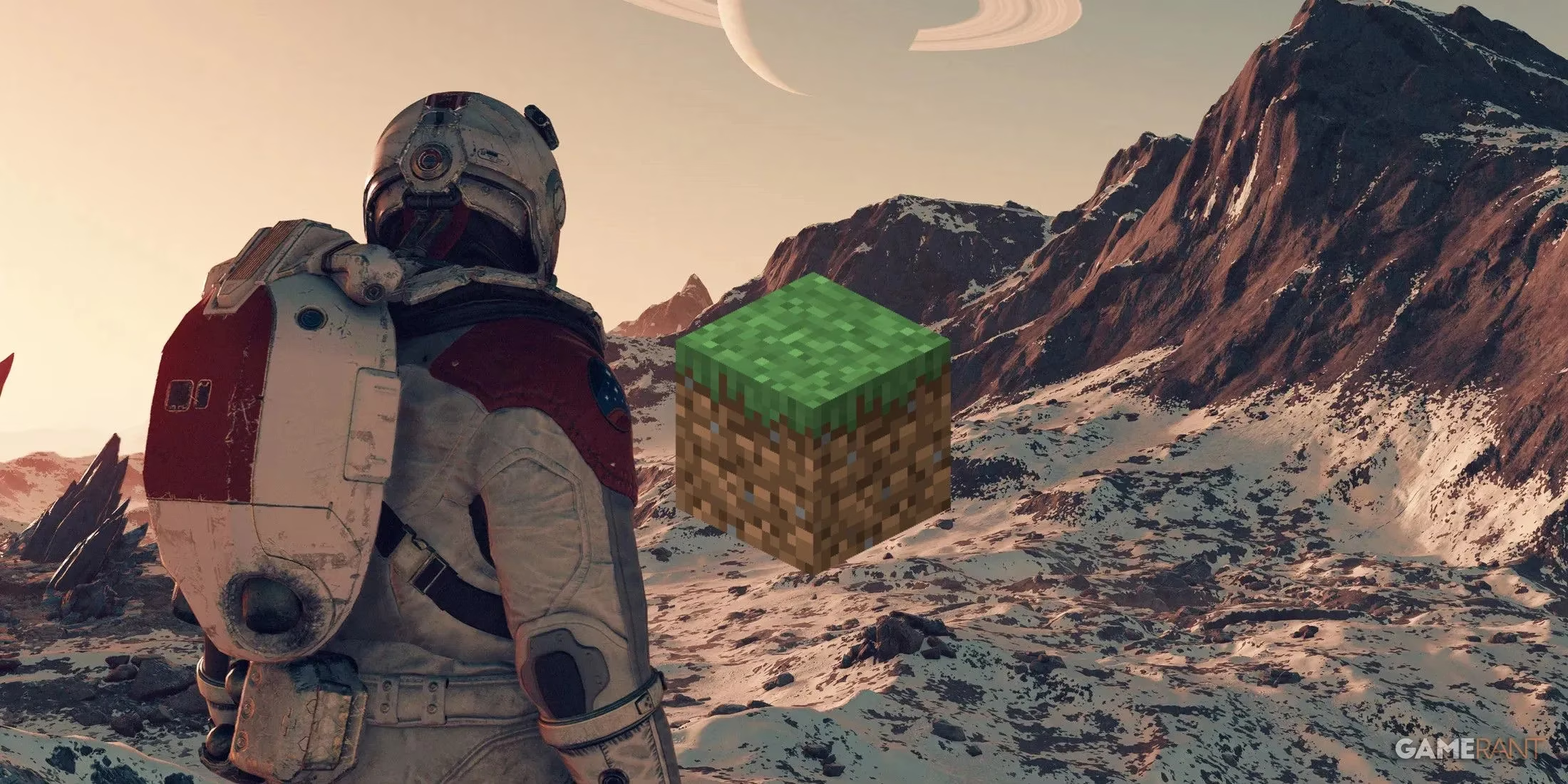
The Redemption Arc: When Updates Hit the Mark
If there's one thing I've learned following Starfield, it's that a game's launch is just the beginning. The most substantial shift in perception didn't come from a massive, paid expansion, but from a free update: the REV-8. This patch was a masterclass in addressing player feedback directly. It tackled one of the most common and valid complaints head-on—the slow, often tedious process of planetary traversal. By introducing more dynamic and engaging methods to explore those vast, alien landscapes, the REV-8 didn't just add a feature; it fundamentally altered the game's rhythm and flow. It felt like the developers were listening.
Around the same period, the 60FPS performance patch for Xbox Series X arrived, which was another crucial win. It polished the technical experience and quieted a lot of the persistent criticism about optimization—a critique that has, fairly or not, followed Bethesda's games for years. These updates demonstrated a clear path forward: targeted, meaningful improvements that directly enhanced the core gameplay loop. They weren't trying to reinvent the wheel; they were just making the existing ride much smoother and more enjoyable. This approach built a lot of goodwill and showed that the game could evolve in positive ways.
The Shattered Space Conundrum: Mismanaged Expectations
Then came Shattered Space. The community's anticipation was palpable, and honestly, I think we all set ourselves up for disappointment. In the years leading up to it, we'd seen monumental expansions like Cyberpunk 2077: Phantom Liberty and the transformative, free updates for No Man's Sky that completely redefined those games. We expected—perhaps unfairly—that Shattered Space would be Starfield's equivalent: a massive, course-correcting overhaul that would sand down all the rough edges and deliver the idealized version of the game we'd imagined before launch.
The reality was different. Looking at it now, Shattered Space was more of a substantial mission pack. It offered a new storyline, some cool gear, and additional side activities. As a piece of content, it was competently made and added more hours to the game. But it wasn't revolutionary. It didn't overhaul progression systems or introduce groundbreaking new mechanics. It was simply more Starfield. For players who adored the base game, this was great! More of what they loved. But for those hoping it would address foundational criticisms—like repetitive quest structures or shallow faction systems—it felt like a missed opportunity. The dissonance between expectation and reality was stark.
A Better Path Forward: Lessons from the "Never Finished" Game
This entire journey has highlighted a potential flaw in Bethesda's post-launch strategy: treating updates as sporadic, hyped-up events. Sometimes, like with REV-8, this works. Other times, like with Shattered Space, it leads to a cycle of hype and letdown. What if, instead, Starfield adopted a model closer to a game like Minecraft?
Minecraft is the quintessential "living game." It's never truly "done." It receives a steady stream of updates—new biomes, mobs, blocks, and mechanics—that continually refresh the experience. These updates aren't always massive; sometimes they're smaller quality-of-life improvements or content drops. But their regularity creates a constant sense of evolution and community engagement. The game feels alive because it's always being tended to.
Imagine if Starfield had committed to a similar, more consistent cadence:
-
Quarterly Content Drops: Smaller packs introducing a new unique planet, a faction-themed questline, or a batch of new ship parts.
-
Bi-Annual System Tweaks: Updates focused on refining existing systems, like outpost building, crew management, or space combat.
-
Ongoing Communication: A transparent roadmap showing players what's being worked on, managing expectations from the start.
This approach has several advantages:
-
Manages Expectations: No single update is burdened with the weight of "saving" the game.
-
Sustains Engagement: Players have regular reasons to come back and see what's new.
-
Allows for Iteration: Developers can test new ideas on a smaller scale and integrate community feedback more fluidly.
Starfield doesn't need to become an endlessly updated live-service game, but moving away from the "big bang" update model could have been key to its longevity. It would have allowed the game to improve organically over time, smoothing out its issues and expanding its strengths through a series of smaller, welcomed evolutions rather than infrequent, make-or-break transformations.
The Legacy and The Road Ahead
As of 2026, Starfield's story is one of contrasts. It's a game that was simultaneously criticized for its vast, empty spaces and praised for its moments of profound, quiet exploration. It's a title that benefited immensely from smart, free updates but also stumbled under the weight of its own DLC's hype. Its journey mirrors a larger conversation in gaming about how we support and grow massive titles after release.
The lesson for any studio, in my view, is clear: Listen closely, act deliberately, and communicate constantly. The REV-8 update worked because it solved a real, expressed pain point. The Shattered Space expansion struggled because it couldn't meet inflated, almost mythical expectations. The future of expansive games like this may lie less in monolithic expansions and more in a philosophy of continuous, thoughtful iteration—building a universe alongside the players who call it home, one update at a time.
This discussion is informed by The Verge - Gaming, and it frames Starfield’s post-launch swings as a broader lesson in expectation management: practical, player-pain-point fixes (like traversal and performance improvements) can steadily rebuild goodwill, while heavily hyped expansions risk feeling underwhelming if they mainly deliver “more of the same.” In that light, a Minecraft-like cadence of smaller, predictable updates can keep the conversation focused on tangible iteration rather than make-or-break moments that amplify polarization.