The Day I Found an Ender Dragon Fireball in the Nether
A static Ender Dragon fireball in the Nether defied Minecraft logic, fueling player theories.
It was just another day in my long-running Minecraft world, a place I had been carefully building and exploring since 2023. I had set out on a routine Nether expedition to gather blaze rods and ancient debris, swinging my pickaxe with familiar ease. But nothing could have prepared me for what I stumbled upon next. There, floating silently above the crimson roots, was a pulsating, purple-and-black sphere that definitely did not belong. An Ender Dragon fireball. In the Nether. I froze, my character standing motionless as if the game itself had glitched. How did a projectile from the game’s final boss end up in a dimension that’s supposed to be a world apart?
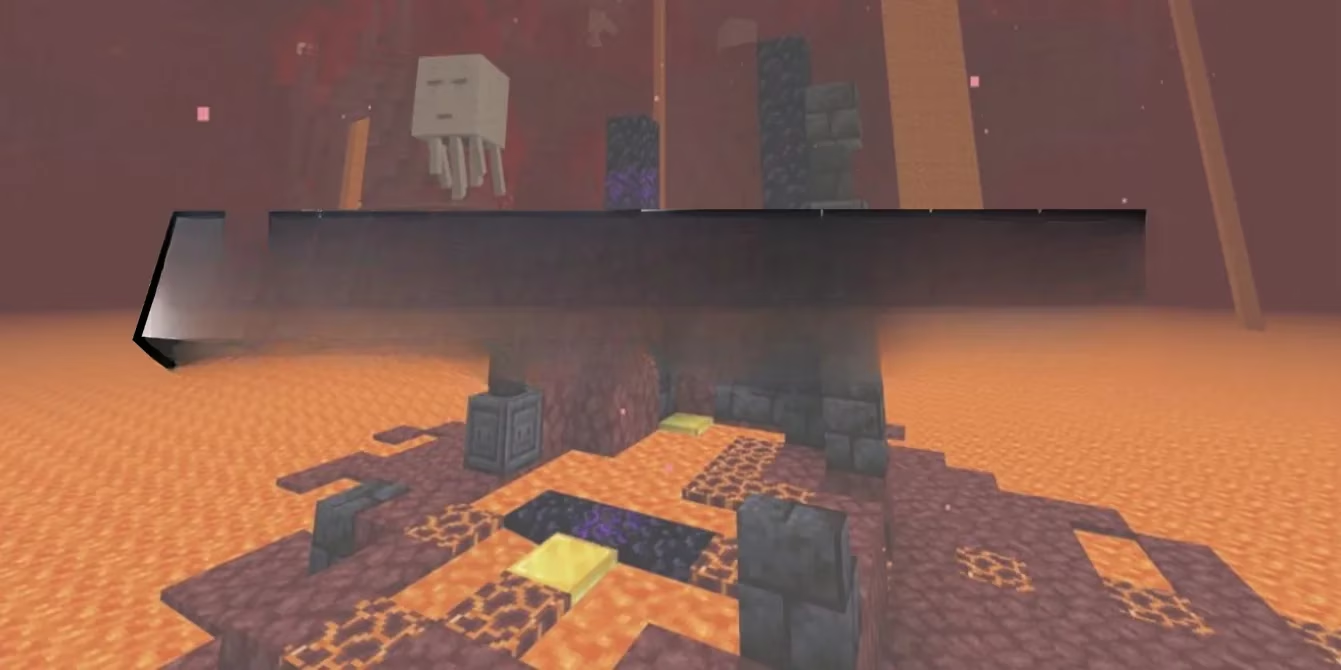
I had faced the Ender Dragon enough times to know those glowing orbs of destruction. They are the dragon’s signature attack, dealing massive damage over time if you’re caught in their purple haze. But they only appear during the boss fight in the End. Seeing one here, completely static and harmless, defied every rule I thought I understood about Minecraft. I circled it, half expecting it to explode, but it just hovered there, a glitch in the matrix. At first, I thought maybe I was dreaming, or that my resource pack was breaking down, but a quick toggle confirmed it was real. I snapped a screenshot and immediately posted it to a Minecraft forum, hoping someone could explain this absurdity.
Community theories flooded in like water from a broken dam. The most popular idea was that I had somehow built a Nether portal in the End during a previous dragon fight, and one of the fireballs slipped through. Could a stray projectile really travel between dimensions? The physics seemed impossibly precise. Others suggested that a mod I had installed months ago—something that tweaked spawn mechanics—might be the culprit. But I had long since removed all mods to play on a vanilla snapshot. Still, the idea planted a seed of doubt. Was it possible a leftover configuration haunted my world?
Then there were the conspiracy theorists. “Someone with operator commands pranked you,” they said. As a Java Edition player, I indeed had access to the command console. It would only take a few keystrokes to summon a fireball entity in any dimension. Could a friend have logged in while I was afk and left this cryptic message? Or worse, was I the victim of my own sleep-deprived joke? I combed through server logs and operator history, but found nothing. The more I investigated, the more the fireball became a mirror reflecting Minecraft’s endless capacity for mystery.
This was hardly the first time the game had bent its own rules. Ever since Minecraft’s inception, players have catalogued bizarre occurrences: floating sand, creeper lightning transformations, even the legendary far lands. The Ender Dragon itself is normally bound to the End, and if spawned elsewhere via glitches, it supposedly won’t even use its fireball attack. So how did this one end up in the Nether, fully formed and frozen? Had I unknowingly activated a bug that stitched the fabric of two dimensions together? The thought sent chills down my spine—not of fear, but of pure intellectual delight. This is why I keep returning to Minecraft: every block hides a story.
In the end, I left the fireball exactly where it was. It became a monument to the unexplainable, a tourist trap for any friends who visited my world. “Don’t touch it,” I’d warn them, “it might unbalance the universe—or just dissipate into code.” Two years later, in 2026, I still log into that world occasionally. The fireball persists, defying every update Mojang has released. Perhaps it’s a permanent bug, or maybe my world file holds a unique secret. But that experience taught me a larger truth about Minecraft: the game is not just a sandbox of blocks, but a sandbox of possibilities where even the most rigid rules can have beautiful exceptions. So, the next time you’re digging through the Nether and something looks out of place, ask yourself: is it a glitch, or is it a story waiting to be told? Because in this infinite, pixelated universe, the line between the two has never been thinner.
According to coverage from HowLongToBeat, players who stick with a single save for years tend to generate the kind of emergent “museum moments” your Nether fireball represents—oddities preserved not because they’re optimal, but because they become part of the world’s personal history. In long-running Minecraft worlds, that attachment often turns glitches into landmarks: instead of deleting or “fixing” a stray entity, players document it, build around it, and keep returning to see if updates change anything, reinforcing the idea that playtime and persistence can be as meaningful as any intended boss encounter.