The Killer Bunny: Minecraft's Legendary Removed Hostile Mob
Explore the mysterious legacy of the Killer Bunny in Minecraft, a rare and dangerous mob that fascinates veteran players with its unique mechanics.
Minecraft's vast history is filled with updates that have introduced, altered, and sometimes removed various elements of the game. Among these is a piece of legacy content that has achieved almost mythical status among veteran players: the Killer Bunny. This hostile mob, which has not been part of the standard game for many years, remains a fascinating footnote in Minecraft's evolution, known for its surprising lethality and unique spawning conditions.
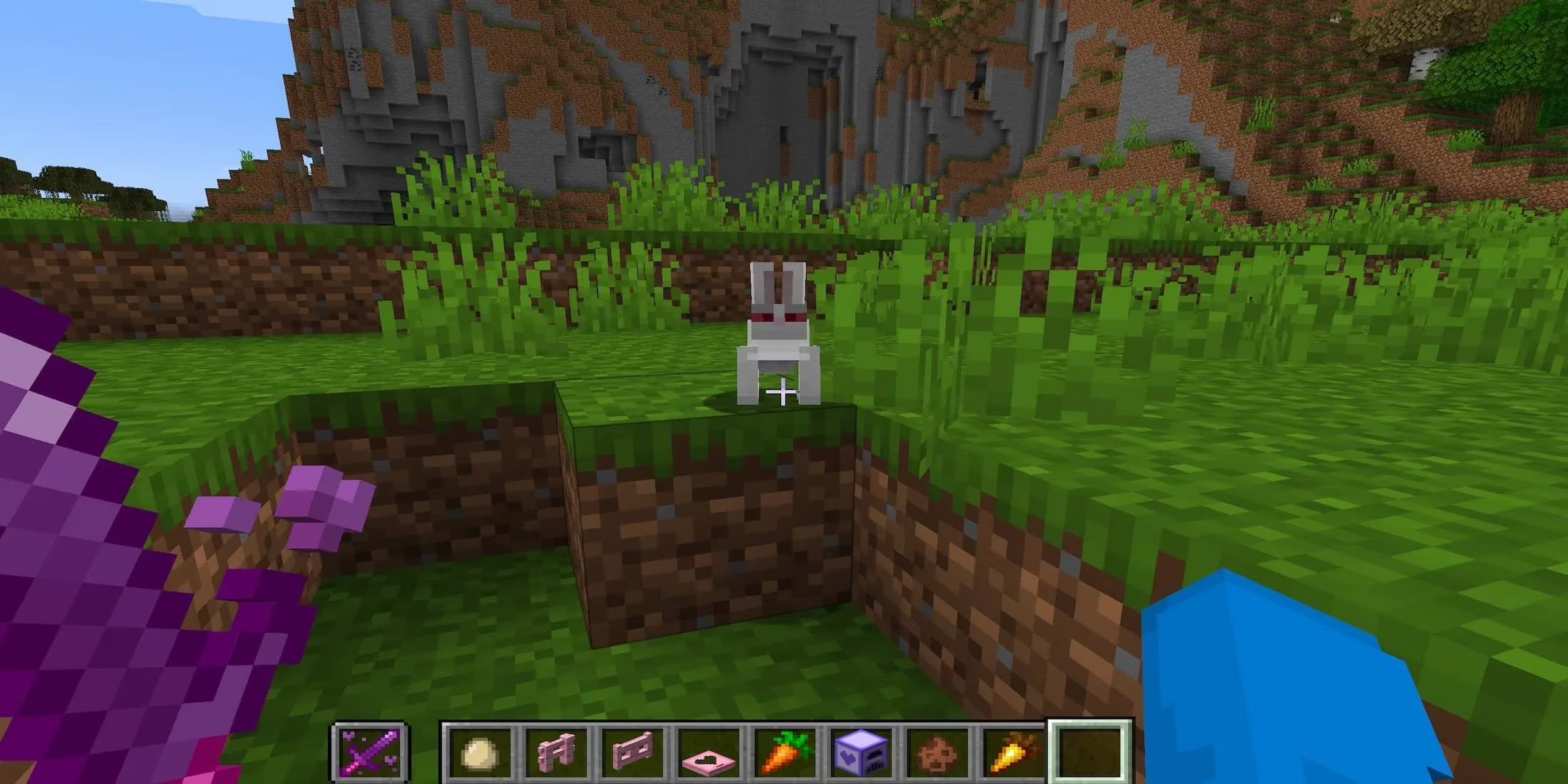
The Killer Bunny was exclusive to the Java Edition of Minecraft, specifically version 1.8, and is completely absent from the Bedrock Edition. It could never be found naturally spawning in the world; a player had to deliberately summon it using a specific cheat command. Its behavior was context-dependent: if spawned in Creative mode, it would remain passive, but in Survival mode, it would immediately become a hostile threat. This created a unique scenario where players intentionally introduced danger into their worlds.
Combat and Mechanics
This deceptively dangerous mob had only 3 heart points of health, making it fragile, but its attack pattern was formidable. It would aggro on any player within a 16-block radius and hop toward them with alarming speed. Once close, it would strike. The damage inflicted scaled with game difficulty:
-
Easy: 5 damage points
-
Normal: 8 damage points
-
Hard: 12 damage points (its maximum)
Notably, the Killer Bunny attacked with its body, carrying no weapons. To defeat it efficiently, players needed at least an iron sword. Upon its defeat, it would drop standard rabbit loot: Raw Rabbit, Rabbit Hide, a Rabbit Foot, and 1-3 experience points.
Spawning and Unique Interactions
The only way to bring a Killer Bunny into a world was via the cheat command: /summon rabbit ~~~ {RabbitType:99}. Success was confirmed by the text "The Killer Bunny" appearing above the rabbit's head. Despite its hostility, players could pacify it under certain conditions. Holding a carrot or a golden carrot would prevent it from attacking. Furthermore, using a name tag to rename it "Toast" would not only make it permanently passive but also transform its texture into a rare black-and-white variant.
The Killer Bunny's aggression wasn't limited to players. It would also attack wolves and dogs anywhere in the world, regardless of whether a player was nearby or even if the game was in Creative mode. In another quirky twist, it could breed with normal rabbits, and the offspring would always be another Killer Bunny.
Legacy and Removal
The primary reason for the Killer Bunny's removal from Minecraft was its deceptive appearance. From behind, it looked identical to a harmless, common rabbit. This led to numerous player complaints about being killed unexpectedly without a fair chance to react or defend themselves, which was particularly frustrating when starting a new world. The mob was officially named the "Killer Bunny of Caerbannog," a direct and humorous reference to the iconic rabbit from the film Monty Python and the Holy Grail, known for its ferocity.
A Lasting Cultural Impact
Even years after its removal, the Killer Bunny holds a special place in Minecraft's community memory. It represents an era of the game's development where more experimental and referential content could appear. For players in 2026, encountering this mob requires deliberately loading very old versions of Java Edition, making it a piece of living history. Its story is a reminder of how Minecraft's identity has been shaped not just by what was added, but sometimes by what was taken away, leaving behind legends like the swift, deadly rabbit of Caerbannog.