The Minecraft Movie: A Blockbuster Adaptation Facing Fan Skepticism
A Minecraft Movie review explores the visual challenges and fan reactions to this bold video game movie adaptation, blending reality and blocks.
As 2026 unfolds, the legacy of the 2025 "Year of Video Game Movie Adaptations" continues to be discussed, with Warner Bros' A Minecraft Movie serving as a prominent case study. Released in April 2025, the film was tasked with a monumental challenge: translating the boundless, blocky creativity of one of the world's most beloved sandbox games into a coherent cinematic narrative. The final trailers, brimming with diamond swords, ghasts, and pandas, promised an epic journey through the Overworld and Nether. Yet, they also ignited a wave of skepticism that highlighted the inherent difficulties of adapting such a uniquely stylized game. Was the film a loving homage or a visually jarring misstep? The answer, it seemed, depended largely on who was watching.
🎬 Blending Blocks and Reality: A Visual Tightrope Walk
The core creative gamble of A Minecraft Movie was its hybrid visual style. The production team aimed to merge the game's iconic, pixelated aesthetic with high-powered animation and live-action performances. In certain moments, this ambition paid off. For instance, the crafting of a diamond sword was a standout scene that managed to feel both authentically Minecraft and cinematically impressive.
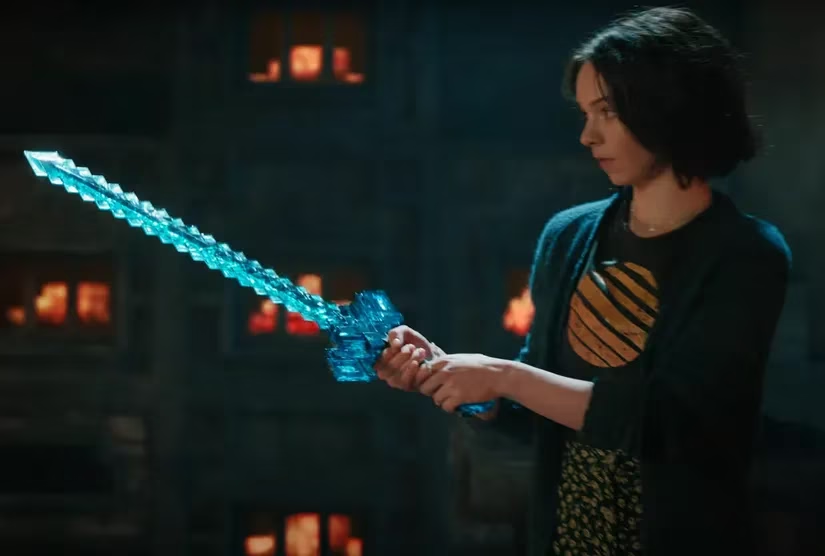
The diamond sword design successfully blended traditional shape with pixelated texture.
However, this fusion proved inconsistent. Scenes featuring live actors exploring the Overworld often felt disjointed, as if the humans and the environment belonged to separate realities. The portrayal of the game's iconic mobs—like pigmen, wolves, and villagers—became a particular point of contention. Rendered in a "half-block, half-real life" style, these creatures struck many viewers as unsettling rather than endearing. A sentiment echoed widely on forums like Reddit was that the designs were "incredibly ugly" and "outright scary," but not in the intentionally spooky way a Nether monster should be. This photorealistic interpretation of a deliberately low-poly style created an uncanny valley effect that alienated a segment of the fanbase.
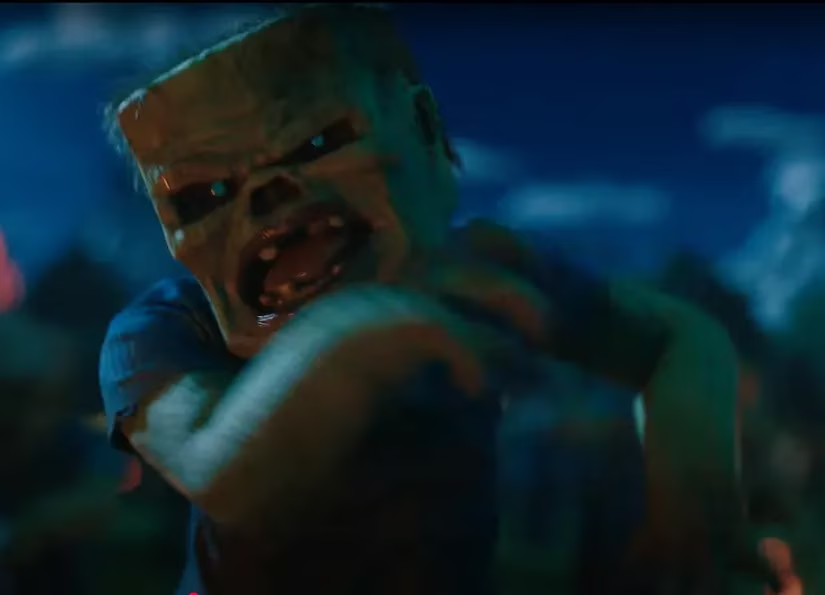
The zombie design exemplified the controversial blend of realistic and blocky elements.
🎭 Character Concerns and Narrative Liberties
Beyond the visuals, the film's narrative and character focus drew scrutiny. The marketing, particularly the final trailers, heavily featured established stars:
-
Jason Momoa in a commanding, vocal role.
-
Jack Black as a pivotal version of Steve.
This spotlight raised questions about the protagonist, Henry. Conceived as an audience surrogate—a symbol of every child who logs into Minecraft—Henry's voice was curiously absent from much of the promotional material. This led to concerns that the film might sideline its emotional core in favor of star power and bombast.
Furthermore, the film took a significant liberty with Minecraft lore by depicting Steve not as a default player avatar but as an actual human character trapped in the game world. While this change served the practical purpose of allowing Jack Black to inhabit the role, it directly contradicted the game's foundational premise. For purists, this was a fundamental alteration of the Minecraft universe's rules. Could such a change be justified if it served the story, or did it undermine the very essence of the property it was adapting?
📊 The Target Audience Paradox
The divided reaction to A Minecraft Movie ultimately underscored a classic adaptation paradox. The film's primary target was clearly children—the newest generation of players. Its box office success in 2025 demonstrated that for this core demographic, the spectacle of seeing their favorite game on the big screen was often enough. The movie was designed to be a colorful, action-packed adventure first and a faithful translation second.
Yet, Minecraft's cultural footprint is vast. The game, having existed for over a decade and a half by 2026, boasts a massive audience of adults who grew up with it. These older fans, viewing the trailers with a more critical and nostalgic eye, formed the backbone of the online skepticism. Their expectations were shaped by years of personal experience within the game's open-ended world, making them more sensitive to perceived tonal or aesthetic missteps.
| Audience Segment | Primary Concern | Likely Reception |
|---|---|---|
| Children (Target Demo) | Fun, action, recognizable characters | Generally positive, focused on spectacle |
| Adult / Long-time Fans | Artistic fidelity, tone, respect for lore | Mixed to critical, sensitive to changes |
| General Moviegoers | Entertaining story, visual coherence | Dependent on film's standalone quality |
🔮 Legacy and Lessons for Future Adaptations
Looking back from 2026, A Minecraft Movie stands as a fascinating artifact in the ongoing evolution of game-to-film adaptations. It proved that even a project facing significant pre-release skepticism could achieve commercial success by appealing directly to its intended young audience. The film's performance showed that the power of the Minecraft brand was immense enough to draw crowds, regardless of critical debates.
However, the passionate discourse it sparked also delivered clear lessons for studios:
-
Visual Translation is Key: Adapting a game with a strong, non-realistic art style requires extremely careful design choices to avoid alienating the original fanbase.
-
Respect the Core Fantasy: While creative liberties are necessary for cinema, fundamental changes to a property's central premise carry a high risk.
-
Balance Nostalgia with Accessibility: A successful adaptation must walk the line between honoring the long-time fans who built the community and welcoming new audiences.
In the end, A Minecraft Movie was a blockbuster experiment. It asked whether the serene, creative solitude of Minecraft could be repackaged as a Hollywood hero's journey. The answer, much like the game itself, was multifaceted and deeply dependent on the perspective of the player—or in this case, the viewer. The film's journey from skeptical trailers to box office queues remains a compelling chapter in the story of how our digital playgrounds are transformed for the silver screen. 🎥⛏️