The Rediscovery of the Lost Herobrine Stream: A Minecraft Legend Restored
The long-lost 2010 Herobrine Minecraft stream by Copeland, unearthed in 2024, revitalized the notorious hoax that haunted players.
Deep within the infinite blocky landscapes of Minecraft, myths have a curious way of entrenching themselves into the very fabric of the game. Among these digital campfire tales, none has gripped the community quite like that of Herobrine—a mysterious, white-eyed doppelganger of the default player avatar Steve, said to haunt servers and worlds with an unnerving stillness. For over a decade and a half, the story has been shared, embellished, and debunked, yet its grip on the imagination has never fully loosened. In 2024, a vital artifact of this folklore was dramatically resurrected when the long-lost original stream that propelled Herobrine from obscure creepypasta to global phenomenon was unearthed and republished, allowing a new generation of players to witness the exact moment the legend became immortal.
The Herobrine myth did not begin with the stream, but it was the stream that etched it permanently into Minecraft's cultural memory. The earliest seeds were planted in 2010, when an anonymous player on the 4chan board '/v/' shared a screenshot of an apparently glitched Steve-model figure staring at them from the morning fog. The poster’s subsequent attempts to investigate were met with peculiar pushback: their threads were mysteriously deleted, and a user named "Herobrine" sent them a chilling private message demanding they stop digging. Whispers quickly spread that this entity was either the ghost of Notch’s dead brother—an erroneous theory since Notch, the creator of Minecraft, never had a sibling—or perhaps Notch himself, lurking in the code. The truth was far simpler, yet the community’s willingness to believe transformed a prank into a proto–internet legend.
What the myth needed was motion. A single screenshot could be misunderstood; a video of Herobrine appearing in real time, however, would be irrefutable proof for the believers and a masterstroke of horror for the skeptical. That video arrived from a Minecraft streamer named Copeland. In the early days of live streaming, technical setups were rudimentary, and the novelty of broadcasting one’s gameplay was enough to draw an audience. Copeland, aware of the growing Herobrine chatter, decided to orchestrate a hoax that would become more famous than the truth. For hours, his stream showed nothing more than routine mining and crafting. Viewers grew bored, their attention drifting. Then, at precisely the right moment, Copeland entered a previously avoided room in his blocky abode, and there it was: a figure identical to his player character but with luminescent, vacant eyes, standing motionless among the cobblestone. The streamer’s reaction—a genuine shriek followed by a panicked escape and the immediate termination of the broadcast—was flawless. The clip spread like wildfire across forums and early YouTube, embedding the Herobrine scare into the psyche of millions.
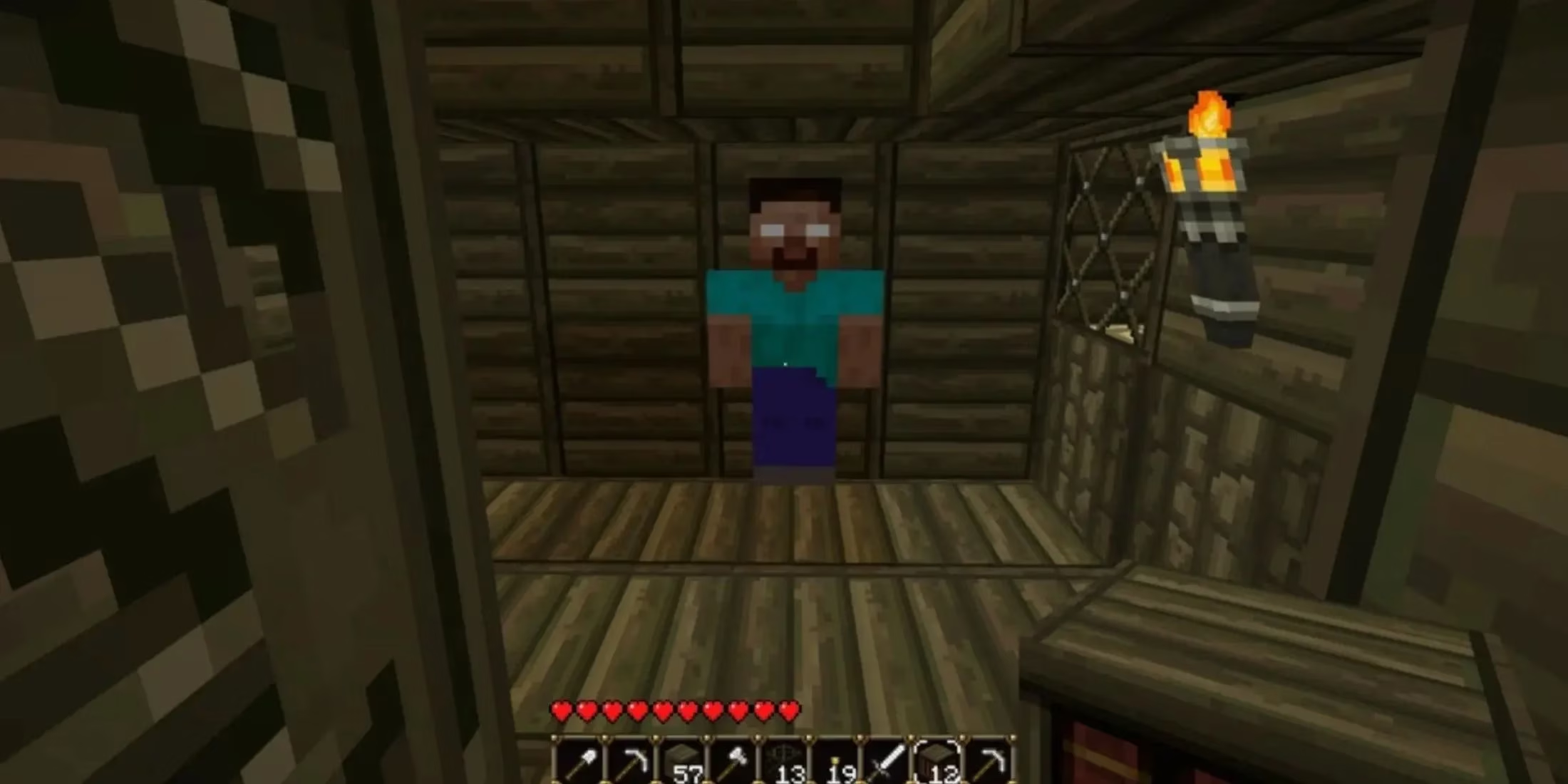
Tragically, just a year after that fateful broadcast, the original video vanished from the internet. Hosting platforms came and went, accounts were abandoned, and the primary source for one of gaming’s most iconic moments was thought to be lost forever—a gap in digital history akin to a missing early film reel. For nearly fifteen years, fans could only recount the experience secondhand, relying on blurry reuploads, third-party reaction videos, or textual descriptions that could never capture the eerie stillness of the encounter. Hardcore myth hunters scoured archives and contacted old community members, but the stream seemed to have evaporated into the same mystery from which Herobrine itself had emerged.
Then, in the summer of 2024, a twist worthy of the legend itself unfolded. A YouTuber known as brutallillfjomp, who had been engaged in a community effort to document and preserve Minecraft’s earliest and most influential stories, stumbled upon a crucial piece of information. While watching recent retrospective videos about the Herobrine phenomenon and Copeland’s role in it, brutallillfjomp realized something extraordinary: he still possessed a local copy of the original stream file, downloaded ages ago and buried on a dusty hard drive. The stream, presumed extinct by the entire community, had been silently sitting in his archive, unscathed by time. Recognizing its immense historical and sentimental value, brutallillfjomp acted swiftly. He uploaded the full, unedited stream footage to his own YouTube channel, accompanying it with a simple explanation and a time stamp for the chilling event at 20 minutes and 42 seconds. The announcement sent ripples of excitement through the Minecraft fandom, as veteran players and curious newcomers alike finally gained access to the foundational artifact.
The reupload was more than just a nostalgic novelty; it was a restoration of collective memory. The video itself, in retrospect, is almost disarmingly crude by modern standards. There are no elaborate special effects, no custom mods with complex triggers. Copeland later confessed that he had simply placed a painting of Herobrine retextured to look like the entity in his base and deliberately evaded that room for the entire stream to build a credible, low‑tech jumpscare. The banal realism of the setup—a player walking into a room and finding something that shouldn't be there—was precisely why it worked so well. The stream’s rediscovery invites viewers to appreciate the simplicity and genius of early Minecraft storytelling, a time when the game’s sparse graphics left vast empty spaces for the imagination to populate with horrors.
By 2026, the recovered stream has become a cornerstone of Minecraft’s educational and cultural preservation efforts. Modding historians cite it as a pivotal moment that inspired countless subsequent creepypastas, mods, and map designs. Server administrators regularly host watch parties on the anniversary of the original broadcast, and video essayists dissect its influence on horror tropes in sandbox games. The myth of Herobrine, though conclusively debunked as a hoax countless times by Mojang itself (who famously jokingly included “removed Herobrine” in numerous patch notes), remains an integral part of the game’s identity largely because of Copeland’s performance and its long‑awaited second coming via brutallillfjomp’s upload.
The saga highlights how fragile digital history can be, and how a single dedicated individual can rescue a piece of culture from oblivion. What was once a prank performed for a few dozen viewers is now an accessible monument to the internet’s capacity for collective mythmaking. As the years roll on and Minecraft continues to evolve, the ghostly figure with the empty white eyes will still be standing in that room, staring endlessly, waiting for the next curious player to open the door—and thanks to a recovered video file, everyone can now look over that player’s shoulder and scream along.